|
|
Supply
Supply
The Graphical Approach
Economists graphically represent the relationship between product
price and quantity supplied with a supply curve. Typically, supply
curves are upwards sloping, because as price increases, sellers are
more likely to be willing to sell something. For instance, if someone
offered you $10 for one of your favorite shirts, you might not want to
part with it, since it wouldn't be worth it. However, if someone
offered you $500 for that same shirt, you would probably consider it.
Each individual seller can have their own supply curve, showing how
many products they are willing to sell at any given price, as shown
below. This graph shows what James's supply curve for hours of
tutoring in economics might be:
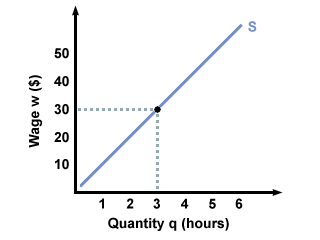
Figure 1.1: James's Supply Curve
To find out how many hours of tutoring James will give for a given
wage (when we put a price on hours of work, we call it a wage),
extend a perpendicular line from the price on the y-axis to his
supply curve. At the point of intersection, extend a line from the
supply curve to the x-axis (perpendicular to the x-axis). Where it
intersects the x-axis (quantity) is how many hours of tutoring
James will teach. For instance, in the graph above, James will teach
for 3 hours when the hourly wage is $30 an hour.
Typically, however, economists don't look at individual supply
curves. Instead, they look at aggregate supply, the combined quantities
supplied by all potential sellers. To do this, you add the quantities
that sellers are willing to sell at different prices, just like we do
to find aggregate demand. For instance, if James and Ina are the
only two tutors in the market for economics tutoring, we would add how
many hours they are willing to tutor at wage w=20 and record
that as aggregate demand for w=20. Then we would add how many
they are willing to tutor at wage w=30 and record that as
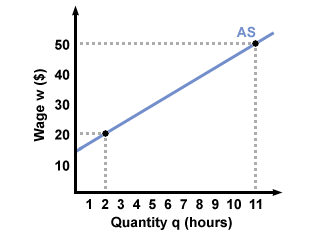
aggregate demand for w=30, and so on. Combining the two supply curves in
the first graph results in the aggregate supply curve in the second graph:
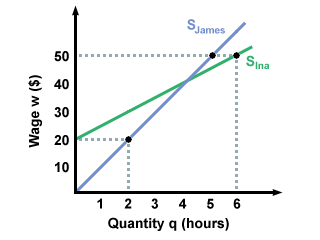
Figure 1.2: Two Supply Curves
Figure 1.3: Aggregate Supply Curve
Since at w=20 James is unwilling to work and Ina is willing to work 2
hours, at w=20 the aggregate supply curve equals 2 hours. At
w=30, James is willing to work 5 hours and Ina 6, so at w=20 the
aggregate supply curve equals 11 hours. This method is called horizontal
addition, since we add across each price level to find the total quantity
supplied.
There are two ways that supply quantity can change: one is through movements
along the same supply curve, the other is through shifts in the supply curve.
Let's look at the first one: movements along one supply curve.
Movements along one supply curve follow the same idea as movements along a
single demand curve: nothing is changing except for the price of the good, so
the only thing influencing supply is a change in price. With all else being
equal, we can see how James might change how much he is willing to tutor when
his wage rises or falls in the following graph:
Figure 1.4: James's Supply Curve
Note that when the wage is higher, the quantity supplied is higher,
and vice versa. The reservation price (or in this case, the reservation
wage) is the lowest price that a seller is willing to accept for its products.
Most firms will sell products up to the point where their profits are 0, or
where the amount they spend to make and sell the product is equal to the amount
they receive for the product on the market. To find the reservation wage on
James's supply curve, find the point where his quantity supplied will be 0. The
reservation price will be marginally higher than the price at Q = 0. If we
assume that James can only tutor in hourly increments (that is, he can't tutor
for less than an hour), then his reservation wage will be the wage at which he
will only tutor for one hour. On the graph, it looks like James's reservation
wage will be about $10/hour.
The other way in which supply quantity can change is through actual shifts in
the supply curve. If you recall when we studied shifts in demand curves, you
will remember that such shifts are caused by outside factors. While demand
curves are shifted by changes in income or changes in preferences, supply curves
can be affected by changes in profit. Profit is how much a firm actually
gains when they make a sale. For instance, if a bookstore buys a used book for
$1 and sells it for $5, their profit is $4. Changes in the selling price of the
book can change how many books they are willing to sell, and such changes would
be represented by sliding up and down the same supply curve, as in the previous
example. If the price the bookstore has to pay for the book changes, however,
that would cause their supply curve to shift, even if the selling price doesn't
change. If they have to pay more for the book, their profits drop, and make
them less willing to sell books at prices they were willing to sell at before
the change. We can see this below:
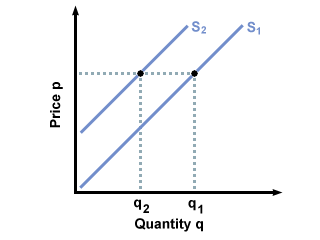
Figure 1.5: A Shift in the Supply Curve
Notice that for any given price, the store will sell fewer books than before,
reflecting the higher costs and lower profits they get for each book. Without
changing the price at which they sell the book, we have shifted their supply
curve and changed their willingness to sell. Thus, changes in profits can shift
a firm's supply curve, even if the market price stays constant. We will later
learn how to graphically visualize a firm's profits in a given market by using
their different costs, sources of income, and the market price and demand.
The Algebraic Approach
As with demand, it is also possible to model supply using equations. These
supply equations, or supply functions, are used to numerically represent firm
behavior and the variation of firm behavior with price. For simplicity's sake,
we will again use simple algebraic equations.
If Amy's bookstore sells textbooks with a supply curve that looks like this:
Figure 1.6: Amy's Bookstore's Supply Curve
The corresponding equation that describes the bookstore's supply of textbooks
will be the equation for the line, or:
Q = -10 + P
If we want to see how many books the store is willing to sell if the
price is $50, we plug 50 in for P and solve for Q. In this case,
Q = [-10 + 50] = 40 textbooks
If we want to solve for aggregate supply using the algebraic approach
instead of the graphical approach, we just add the supply equations
together. So, if we're adding Amy's bookstore's supply to Tony's
bookstore's supply, it will look like this:
Figure 1.7: Aggregate Supply
If price is still equal to 50, we find out that together, Amy and Tony
will sell
Q = [-15 + 2.5(50)] = 110 textbooks
One caveat: It is possible that some supply functions will sometimes
give a negative quantity for some prices. For instance, the supply equation for
Amy's bookstore will give a negative quantity supplied if the price is under $10
per textbook. Since it is impossible to supply a negative quantity of
textbooks, for values under $10 the store will not sell any textbooks. Before
adding together two or more supply equations, always check to make sure that
none of them will give you negative results for the price for which you are
solving.
To find the reservation price when working with supply functions, set Q
equal to 0 and solve for P. The reservation price will be marginally higher
than P when Q is equal to 0. For instance, if we want to find Amy's reservation
price:
Q = -10 + P
0 = -10 + P
P = 10
Amy's reservation price will be marginally higher than $10. Assuming that she
can only sell whole books (that is, she can't sell 1/2 of a book), then her
reservation price will be the price when her supply quantity will be 1:
1 = -10 + P
P = $11 per textbook
If we want to see how supply can change even without a change in the market
price, we need to look at utility. While buyers get their utility from their
preferences and needs, firms get their utility from profit. Basically, profit
is how much a seller actually gains by making a sale (and what we use to measure
how happy the seller will be), and is derived by subtracting the costs from
income. The simplest form of the profit equation is as follows:
Profit = Total Revenue (TR) - Total Cost (TC)
For instance, if an ice cream store pays $500 in rent, $500 in wages,
and $200 for ice cream each month, and they sell 500 ice cream cones at
$3 each, then their profit each month is:
[(500)(3) - (500 + 500 + 200)] = $300.
One thing that can change their profit margin is the price. We know from before
that changes in price are reflected in movements along one supply
curve. However, changes in their costs, such as rent, wages, or
gallons of ice cream can cause their supply curve to shift, since any
of these changes would affect their willingness to sell ice cream at a
given price.
We can see how this works when we change how much rent the ice cream store
has to pay each month without changing the price they charge for an ice cream
cone. If the monthly rent increases to $600, and nothing else changes, then
their monthly profits will fall to $200. If you were the ice cream store owner,
and you had this happened to you, how willing would you be to sell ice cream
cones? Last month, you sold 500 cones and made $300. This month, you would
have to work just as hard to make less money. It is easy to see why firms can
be affected by more than just the price of a good when deciding how much to
sell, and it is these considerations that can cause shifts in their supply
curves.
  Help |
Feedback |
Make a request |
Report an error |
Send to a friend
|
|