No Fear Translations of Shakespeare’s plays (along with audio!) and other classic works
Flashcards
Mastery Quizzes
Infographics
Graphic Novels
AP® Test Prep PLUS
AP® Practice & Lessons
My PLUS Activity
Note-taking
Bookmarking
Dashboard
Annual
$22.49/month + tax
Save
25%
on 2-49 accounts
Annual
$20.99/month + tax
Save
30%
on 50-99 accounts
Focused-studying
Ad-free experience
Study Guides for 1,000+ titles
Full Text content for 250+ titles
PLUS Study Tools
No Fear Translations of Shakespeare’s plays (along with audio!) and other classic works
Flashcards
Mastery Quizzes
Infographics
Graphic Novels
AP® Test Prep PLUS
AP® Practice & Lessons
My PLUS Activity
Note-taking
Bookmarking
Dashboard
Testimonials from SparkNotes
Customers
No Fear
provides access to Shakespeare for students who normally couldn’t (or wouldn’t) read his plays.
It’s also a very useful tool when trying to explain Shakespeare’s wordplay!
Erika M.
I
tutor high school students in a variety of subjects. Having access to the literature
translations helps me to stay informed about the various assignments. Your summaries and
translations are invaluable.
Kathy B.
Teaching Shakespeare to today's generation can be challenging. No Fear helps a ton with
understanding the crux of the text.
Kay
H.
Testimonials from SparkNotes Customers
No Fear provides access to Shakespeare for students who normally couldn’t (or wouldn’t) read his plays. It’s also a very useful tool when trying to explain Shakespeare’s wordplay!
Erika M.
I tutor high school students in a variety of subjects. Having access to the literature translations helps me to stay informed about the various assignments. Your summaries and translations are invaluable.
Kathy B.
Teaching Shakespeare to today's generation can be challenging. No Fear helps a ton with understanding the crux of the text.
Kay H.
Create Account
Select Plan
3
Payment Info
4
Start 7-Day Free Trial!
Payment Information
You will only be charged after the completion of the 7-day free trial.
If you cancel your account before the free trial is over, you will not be charged.
You will only be charged after the completion of the 7-day free trial. If you cancel your account before the free trial is over, you will not be charged.
Order Summary
Annual
7-day Free Trial
SparkNotes PLUS
$29.99 / year
Annual
Quantity
51
PLUS Group Discount
$29.99 $29.99 / seat
Tax
$0.00
SPARK25
-$1.25
25% Off
Total billed on Nov 7, 2024 after 7-day free trail
By saving your payment information you allow SparkNotes to charge you for future payments in accordance with their terms.
Powered by stripe
Legal
Google pay.......
Welcome to
Thank You!
Your group members can use the joining link below to redeem their membership. They will be prompted to log into an existing account or to create a new account.
All members under 16 will be required to obtain a parent's consent sent via link in an email.
Your Child’s Free Trial Starts Now!
Thank you for completing the sign-up process. Your child’s SparkNotes PLUS login credentials are [email] and the associated password.
If you have any questions, please visit our help center.
Your Free Trial Starts Now!
Please wait while we process your payment
Parent’s Email is Required
A parent must help manage your account. Enter their email below and we’ll send them a link to finish signing
up for SparkNotes PLUS.
We’ve sent an email to parentsname@email.com. In order to access
SparkNotes PLUS, your parent must click the link provided in the email.
We’ve sent an email to parentsname@email.com. In order to access
SparkNotes PLUS, your parent must click the link provided in the email.
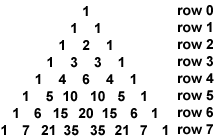
Pascal's Triangle is a triangle in which each row has one more entry than
the preceding row, each row begins and ends with "1," and the interior elements
are found by adding the adjacent elements in the preceding row. The triangle is
symmetrical.
Figure %: Pascal's Triangle
In Row 6, for example, 15 is the sum of 5 and 10, and 20 is the sum of 10 and
10. Note that the triangle begins with Row 0.
We can find any element of any row using the combination function. The rth element
of Row n is given by:
C(n, r - 1) =
For example, the 3rd entry in Row 6 (r = 3, n = 6) is
C(6, 3 - 1) = C(6, 2) = = 15.
Examples
What is the 5th entry in the Row 7 of Pascal's Triangle? C(7, 4) = = 35.
What is the 6th entry in Row 5 of Pascal's Triangle? C(5, 5) = = 1
What is the 9th entry in Row 20 of Pascal's Triangle? C(20, 8) = = 125970
What is the 2nd entry in Row 103 of Pascal's Triangle? C(103, 1) = = 103







 Ad-free experience
 Study Guides for 1,000+ titles
 Full Text content for 250+ titles
 No Fear Translations of Shakespeare’s plays (along with audio!) and other classic works
 Flashcards
 Mastery Quizzes
 Infographics
 Graphic Novels
 AP® Practice & Lessons
 Note-taking
 Bookmarking
 Dashboard












 = 15
= 15 = 35
= 35 = 1
= 1 = 125970
 = 103
= 103