Did you know you can highlight text to take a note?
x

Please wait while we process your payment


If you don't see it, please check your spam folder. Sometimes it can end up there.
If you don't see it, please check your spam folder. Sometimes it can end up there.
Please wait while we process your payment
Get instant, ad-free access to our grade-boosting study tools with a 7-day free trial!
Learn more



This site is protected by reCAPTCHA and the Google Privacy Policy and Terms of Service apply.
Create Account
Select Plan
Payment Info
Start 7-Day Free Trial!

Annual
2-49 accounts
$22.49/year + tax
50-99 accounts
$20.99/year + tax
Select Quantity
Price per seat
$29.99 $--.--
Subtotal
$-.--
Want 100 or more? Request a customized plan
You could save over 50%
by choosing an Annual Plan!

SAVE OVER 50%
compared to the monthly price!
| Focused-studying | ||
 Ad-free experience Ad-free experience |
 |
|
 Study Guides for 1,000+ titles Study Guides for 1,000+ titles |
|
|
 Full Text content for 250+ titles Full Text content for 250+ titles |
|
|
| PLUS Study Tools | ||
 No Fear Translations of Shakespeare’s plays (along with audio!) and other classic works No Fear Translations of Shakespeare’s plays (along with audio!) and other classic works |
|
|
 Flashcards Flashcards |
|
|
 Mastery Quizzes Mastery Quizzes |
|
|
 Infographics Infographics |
|
|
 Graphic Novels Graphic Novels |
|
|
| AP® Test Prep PLUS | ||
 AP® Practice & Lessons AP® Practice & Lessons |
|
|
| My PLUS Activity | ||
 Note-taking Note-taking |
|
|
 Bookmarking Bookmarking |
|
|
 Dashboard Dashboard |
|
|
$22.49/month + tax
Save 25%
on 2-49 accounts
$20.99/month + tax
Save 30%
on 50-99 accounts
| Focused-studying | ||
| Ad-free experience |
|
|
| Study Guides for 1,000+ titles |
|
|
| Full Text content for 250+ titles |
|
|
| PLUS Study Tools | ||
| No Fear Translations of Shakespeare’s plays (along with audio!) and other classic works |
|
|
| Flashcards |
|
|
| Mastery Quizzes |
|
|
| Infographics |
|
|
| Graphic Novels |
|
|
| AP® Test Prep PLUS | ||
| AP® Practice & Lessons |
|
|
| My PLUS Activity | ||
| Note-taking |
|
|
| Bookmarking |
|
|
| Dashboard |
|
|

No Fear provides access to Shakespeare for students who normally couldn’t (or wouldn’t) read his plays. It’s also a very useful tool when trying to explain Shakespeare’s wordplay!

Erika M.
I tutor high school students in a variety of subjects. Having access to the literature translations helps me to stay informed about the various assignments. Your summaries and translations are invaluable.

Kathy B.
Teaching Shakespeare to today's generation can be challenging. No Fear helps a ton with understanding the crux of the text.

Kay H.
No Fear provides access to Shakespeare for students who normally couldn’t (or wouldn’t) read his plays. It’s also a very useful tool when trying to explain Shakespeare’s wordplay!
Erika M.
I tutor high school students in a variety of subjects. Having access to the literature translations helps me to stay informed about the various assignments. Your summaries and translations are invaluable.
Kathy B.
Teaching Shakespeare to today's generation can be challenging. No Fear helps a ton with understanding the crux of the text.
Kay H.
Create Account
Select Plan
Payment Info
Start 7-Day Free Trial!
You will only be charged after the completion of the 7-day free trial.
If you cancel your account before the free trial is over, you will not be charged.
You will only be charged after the completion of the 7-day free trial. If you cancel your account before the free trial is over, you will not be charged.
Order Summary
Annual
7-day Free Trial
SparkNotes PLUS
$29.99 / year
Annual
Quantity
51
PLUS Group Discount
$29.99 $29.99 / seat
Tax
$0.00
SPARK25
-$1.25
25% Off
Total billed on Nov 7, 2024 after 7-day free trail
$29.99
Total billed
$0.00
Due Today
$0.00
Promo code
This is not a valid promo code
Card Details
By placing your order you agree to our terms of service and privacy policy.
By saving your payment information you allow SparkNotes to charge you for future payments in accordance with their terms.
Powered by stripe
Legal
Google pay.......



Please wait while we process your payment

Sorry, you must enter a valid email address
By entering an email, you agree to our privacy policy.
Please wait while we process your payment
Sorry, you must enter a valid email address
By entering an email, you agree to our privacy policy.
Please wait while we process your payment

Your PLUS subscription has expired
Please wait while we process your payment


Please wait while we process your payment
Duration of the Cell Cycle
The length of the cell cycle is important because it determines how quickly an organism can multiply. For single-celled organisms, this rate determines how quickly the organism can reproduce new, independent organisms. For higher-order species the length of the cell cycle determines how long it takes to replace damaged cells. The duration of the cell cycle varies from organism to organism and from cell to cell. Certain fly embryos sport cell cycles that last only 8 minutes per cycle! Some mammals take much longer than that--up to a year in certain liver cells. Generally, however, for fast-dividing mammalian cells, the length of the cycle is approximately 24 hours.
Most of the differences in cell cycle duration between species and cells are found in the duration of specific cell cycle phases. DNA replication, for example, generally proceeds faster the simpler the organisms. One reason for this trend is simply that prokaryotes have smaller genomes and not as much DNA to be replicated. Across species and organismal complexity, embryonic cells have an increased need for rapidity in the cell cycle because they need to multiply for the development of the embryo. Early embryonic cell cycles often omit G1 and G2 and quickly proceed through successive rounds of S phase and mitosis. For these cells, the main concern is not the regulation of the cell cycle (which occurs largely in G1 and G2), but rather in the speed of cell proliferation.
In this section, we will discuss the breakdown of the durations of mitosis, G1, S phase, and G2 for the general 24 hour cell cycle found in most cells. As we discussed in the previous section, the lengths of G1 and G2 vary in cells based on the individual cell's level of preparedness for proceeding in the cell cycle. Remember, cells can enter G0 for extensive amounts of time during G1 before continuing on to S phase. If a cell has quickly undergone sufficient cell growth or DNA replication, the time spent in G1 and G2 will be decreased.
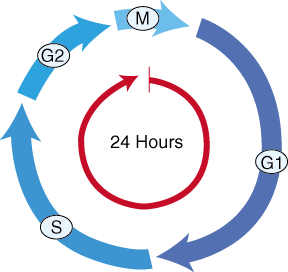
G1 is typically the longest phase of the cell cycle. This can be explained by the fact that G1 follows cell division in mitosis; G1 represents the first chance for new cells have to grow. Cells usually remain in G1 for about 10 hours of the 24 total hours of the cell cycle. The length of S phase varies according to the total DNA that the particular cell contains; the rate of synthesis of DNA is fairly constant between cells and species. Usually, cells will take between 5 and 6 hours to complete S phase. G2 is shorter, lasting only 3 to 4 hours in most cells. In sum, then, interphase generally takes between 18 and 20 hours. Mitosis, during which the cell makes preparations for and completes cell division only takes about 2 hours.
It is possible to determine the time a cell spends in different phases of the cell cycle and its specific location in the cycle by feeding cells with molecules that are only taken into the cell at a specific point in the cell cycle. For example, thymidine is only incorporated into a cell during S phase, and scientists will often use thymidine as a tool to mark the onset of S phase. The amount of DNA present in a cell is also a good indication of where a cell stands in the cell cycle. During S phase, DNA is replicated and, as a result, cells in G2 have higher levels of cellular DNA than cells in G1.
Please wait while we process your payment