Did you know you can highlight text to take a note?
x

Please wait while we process your payment


If you don't see it, please check your spam folder. Sometimes it can end up there.
If you don't see it, please check your spam folder. Sometimes it can end up there.
Please wait while we process your payment
Get instant, ad-free access to our grade-boosting study tools with a 7-day free trial!
Learn more



This site is protected by reCAPTCHA and the Google Privacy Policy and Terms of Service apply.
Create Account
Select Plan
Payment Info
Start 7-Day Free Trial!

Annual
2-49 accounts
$22.49/year + tax
50-99 accounts
$20.99/year + tax
Select Quantity
Price per seat
$29.99 $--.--
Subtotal
$-.--
Want 100 or more? Request a customized plan
You could save over 50%
by choosing an Annual Plan!

SAVE OVER 50%
compared to the monthly price!
| Focused-studying | ||
 Ad-free experience Ad-free experience |
 |
|
 Study Guides for 1,000+ titles Study Guides for 1,000+ titles |
|
|
 Full Text content for 250+ titles Full Text content for 250+ titles |
|
|
| PLUS Study Tools | ||
 No Fear Translations of Shakespeare’s plays (along with audio!) and other classic works No Fear Translations of Shakespeare’s plays (along with audio!) and other classic works |
|
|
 Flashcards Flashcards |
|
|
 Mastery Quizzes Mastery Quizzes |
|
|
 Infographics Infographics |
|
|
 Graphic Novels Graphic Novels |
|
|
| AP® Test Prep PLUS | ||
 AP® Practice & Lessons AP® Practice & Lessons |
|
|
| My PLUS Activity | ||
 Note-taking Note-taking |
|
|
 Bookmarking Bookmarking |
|
|
 Dashboard Dashboard |
|
|
$22.49/month + tax
Save 25%
on 2-49 accounts
$20.99/month + tax
Save 30%
on 50-99 accounts
| Focused-studying | ||
| Ad-free experience |
|
|
| Study Guides for 1,000+ titles |
|
|
| Full Text content for 250+ titles |
|
|
| PLUS Study Tools | ||
| No Fear Translations of Shakespeare’s plays (along with audio!) and other classic works |
|
|
| Flashcards |
|
|
| Mastery Quizzes |
|
|
| Infographics |
|
|
| Graphic Novels |
|
|
| AP® Test Prep PLUS | ||
| AP® Practice & Lessons |
|
|
| My PLUS Activity | ||
| Note-taking |
|
|
| Bookmarking |
|
|
| Dashboard |
|
|

No Fear provides access to Shakespeare for students who normally couldn’t (or wouldn’t) read his plays. It’s also a very useful tool when trying to explain Shakespeare’s wordplay!

Erika M.
I tutor high school students in a variety of subjects. Having access to the literature translations helps me to stay informed about the various assignments. Your summaries and translations are invaluable.

Kathy B.
Teaching Shakespeare to today's generation can be challenging. No Fear helps a ton with understanding the crux of the text.

Kay H.
No Fear provides access to Shakespeare for students who normally couldn’t (or wouldn’t) read his plays. It’s also a very useful tool when trying to explain Shakespeare’s wordplay!
Erika M.
I tutor high school students in a variety of subjects. Having access to the literature translations helps me to stay informed about the various assignments. Your summaries and translations are invaluable.
Kathy B.
Teaching Shakespeare to today's generation can be challenging. No Fear helps a ton with understanding the crux of the text.
Kay H.
Create Account
Select Plan
Payment Info
Start 7-Day Free Trial!
You will only be charged after the completion of the 7-day free trial.
If you cancel your account before the free trial is over, you will not be charged.
You will only be charged after the completion of the 7-day free trial. If you cancel your account before the free trial is over, you will not be charged.
Order Summary
Annual
7-day Free Trial
SparkNotes PLUS
$29.99 / year
Annual
Quantity
51
PLUS Group Discount
$29.99 $29.99 / seat
Tax
$0.00
SPARK25
-$1.25
25% Off
Total billed on Nov 7, 2024 after 7-day free trail
$29.99
Total billed
$0.00
Due Today
$0.00
Promo code
This is not a valid promo code
Card Details
By placing your order you agree to our terms of service and privacy policy.
By saving your payment information you allow SparkNotes to charge you for future payments in accordance with their terms.
Powered by stripe
Legal
Google pay.......



Please wait while we process your payment

Sorry, you must enter a valid email address
By entering an email, you agree to our privacy policy.
Please wait while we process your payment
Sorry, you must enter a valid email address
By entering an email, you agree to our privacy policy.
Please wait while we process your payment

Your PLUS subscription has expired
Please wait while we process your payment


Please wait while we process your payment
Anaerobic Respiration: Homolactic Fermentation
Glycolysis, as we have just described it, is an anaerobic process. None of its nine steps involve the use of oxygen. However, immediately upon finishing glycolysis, the cell must continue respiration in either an aerobic or anaerobic direction; this choice is made based on the circumstances of the particular cell. A cell that can perform aerobic respiration and which finds itself in the presence of oxygen will continue on to the aerobic citric acid cycle in the mitochondria. If a cell able to perform aerobic respiration is in a situation where there is no oxygen (such as muscles under extreme exertion), it will move into a type of anaerobic respiration called homolactic fermentation. Some cells such as yeast are unable to carry out aerobic respiration and will automatically move into a type of anaerobic respiration called alcoholic fermentation.
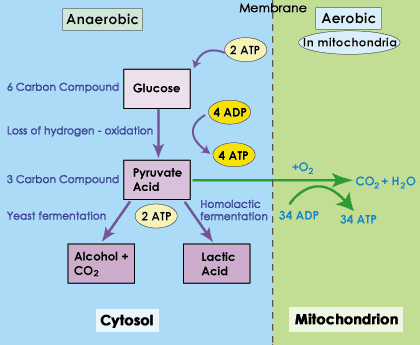
More specifically, the differences in aerobic and anaerobic respiration rest on the different very roles played by the NADH molecule produced in step 5 of glycolysis. In both aerobic and anaerobic respiration, the NADH molecule is part of the enzyme complex and must be restored to its NAD, oxidized state. If there are aerobic conditions, meaning oxygen is available, the NADH molecule can be transported to the mitochondria where it can be immediately converted back to NAD and plays a role in the electron transport chain. However, under anaerobic, oxygen-deficient conditions, NADH gets converted back to NAD through anaerobic mechanisms, whether homolactic or alcoholic fermentation.
Instead of being immediately reoxidized after glycolysis step 5 as it would in aerobic respiration, the NADH molecule remains in its reduced form until pyruvate has been formed at the end of glycolysis. The pyruvate product of glycolysis gets further acted upon under anaerobic conditions by the enzyme lactate dehydrogenase (LDH).
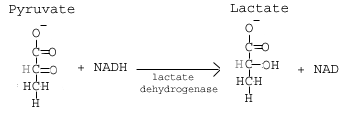
In this reaction, the hydrogen from the NADH molecule is transferred to the pyruvate molecule. This results in its carbon-oxygen double bond being reduced to a carbon-oxygen single bond with the addition of a hydrogen atom. The result is the molecule lactate. From the lactate product, lactic acid can be formed, which causes the muscle fatigue that accompanies strenuous workouts where oxygen becomes deficient.
There is another way that the NADH molecule can be re-oxidized. Anaerobic conditions in yeast convert pyruvate to carbon dioxide and ethanol. This occurs with the help of the enzyme pyruvate decarboxylase which removes a carbon dioxide molecule from the pyruvate to yield an acetaldehyde. The acetaldehyde is then reduced by the enzyme alcohol dehydrogenase which transfers the hydrogen from NADH to the acetaldehyde to yield NAD and ethanol. This enzyme is not found in humans.
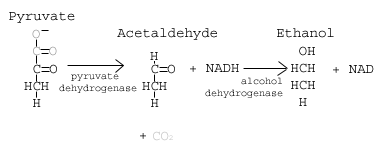
As you can see, both of these anaerobic conditions leads to glycolytic products other than pyruvate. These different products are necessary because the NADH molecule must be reoxidized so that it can function in the next round of glycolysis of newly introduced glucose. If oxygen is not present to help oxidize it, other reactions, such as those of homolactic and alcoholic fermentation, must occur.
Please wait while we process your payment



