






 Ad-free experience
 Study Guides for 1,000+ titles
 Full Text content for 250+ titles
 No Fear Translations of Shakespeare’s plays (along with audio!) and other classic works
 Flashcards
 Mastery Quizzes
 Infographics
 Graphic Novels
 AP® Practice & Lessons
 Note-taking
 Bookmarking
 Dashboard









The division of fungi known as the club fungi, Basidiomycota, includes some of the most familiar fungi. Mushrooms, puffballs, and shelf fungi are all members of this group, as are the plant rusts and smuts. This group, which contains approximately 15,000 known species, is distinguished by the presence of a club- shaped reproductive organ called the basidium. This organ is most likely derived from the ascus found in Ascomycota (see Ascomycota Structure), with which it shares several characteristics. Both originate as a binucleate, dikaryotic structure and serve as a site for karyogamy and meiosis. They differ in that the basidium bears its spores outside while the ascus retains them inside the structure. The role of the basidium in sexual reproduction is discussed in Heading .
Structure
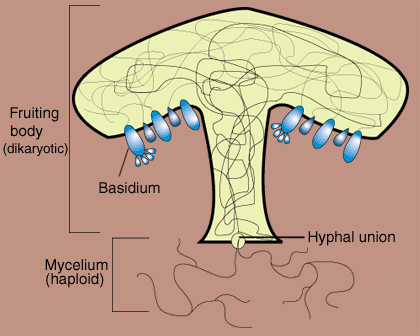
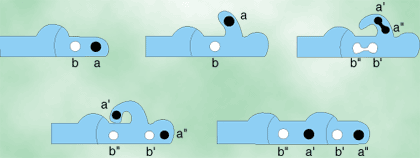
A feature used to identify Basidiomycota, aside from the presence of basidia, is the degree of separation between individual cells. Basidiomycota have more septate hyphae than Zygomycota, though their septae are perforated, allowing cytoplasm to flow freely between cells.
Reproduction
Like all fungi, Basidiomycota can undergo both asexual and sexual reproduction.
Asexual Reproduction
Basidiomycota reproduce asexually by either budding or asexual spore formation. Budding occurs when an outgrowth of the parent cell is separated into a new cell. Any cell in the organism can bud. Asexual spore formation, however, most often takes place at the ends of specialized structures called conidiophores. The septae of terminal cells become fully defined, dividing a random number of nuclei into individual cells. The cell walls then thicken into a protective coat. The protected spores break off and are disbursed.
Sexual Reproduction
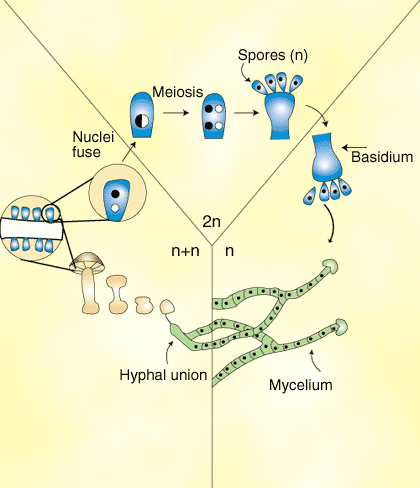
Sexual reproduction in Basidiomycota takes place in the fruiting body, in specialized structures called basidia. The basidia is itself formed by plasmogamy between mycelia from two different spores. Plasmogamy results in binucleate hyphae, that is, hyphae with two types of nuclei, one from each parent. In the gills of the fruiting body, some cells undergo fusion of these two nuclei. These now diploid cells are the basidia. The diploid phase is very brief. Soon after fusion, meiosis takes place, resulting in four haploid nuclei. The nuclei then migrate to the terminus of the basidium and form four individual projections. These projections are then separated by cell walls to become spores.



