Ad-free experience
 Study Guides for 1,000+ titles
 Full Text content for 250+ titles
 No Fear Translations of Shakespeare’s plays (along with audio!) and other classic works
 Flashcards
 Mastery Quizzes
 Infographics
 Graphic Novels
 AP® Practice & Lessons
 Note-taking
 Bookmarking
 Dashboard











Life began on a small scale. The first organisms were single cells. Sometimes small groups of cells formed. Eventually, these microorganisms evolved into complex multicellular organisms. The fact that microorganisms still exist today in many forms is a testament to the quality of this original life form.
Microorganisms have adapted to inhabit almost every corner of the world. They live in the oceans and lakes, where they provide a valuable food source for larger organisms. They live on land where they may the decay of dead organic material, recycling valuable nutrients. Many even live within other, larger organisms that they may help or hinder.
Humans have several reasons to be interested in the study of microorganisms. Many microorganisms cause disease in humans. Bacteria and fungi can be parasites of humans, causing anything from food poisoning to athletes foot to malaria. All viruses are pathogenic, or disease-causing. Viruses are responsible for deadly diseases such as AIDS and polio, as well as milder forms like the common cold. Some viruses have even been implicated in the development of cancer.
We also have several positive relationships with microorganisms. Some soil bacteria fix atmospheric nitrogen, making it available to the plants we eat. Certain fungi grow symbiotically with plant roots, increasing their ability to obtain food and moisture from the soil. Others fungi are themselves quite tasty. Bacteria and protists that live in our intestines help us gain nutrition from food.
Microorganisms have also gained importance as tools in the scientific world. Since most have simple life cycles and can reproduce rapidly, they make ideal model organisms. Topics like genetics that are difficult to study in larger organisms because of the time and expense involved in raising them can easily be studied in microorganisms living in petri dishes by the billions. As gene therapy gains importance for the study and treatment of disease, characterizing viruses that may be used to transport genes is becoming a priority for some scientists.
Overall, microorganisms are some of the most important living creatures. Their roles as producers and recyclers makes them vital in most ecosystems. A greater understanding of these tiny creatures is vital for the study and preservation of our natural environment.
The following topics discuss the various types of microorganisms in depth. Since many microorganisms are unicellular, it is recommended that you be familiar with basic cell biology and reproduction.
A Note on Phylogeny and Taxonomy
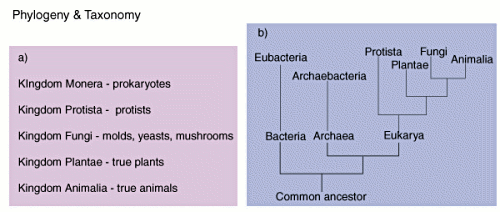
In the following discussion, microorganisms have been divided into the Kingdoms Monera, Protista, and Fungi, as well as the classification Viruses. These designations come from the taxonomic 5 kingdom system commonly used in texts. However, readers should be aware that such classification is often innaccurate in terms of relatedness, or phylogeny. Recent research using molecular biological techniques has given us a wealth of information about the relatedness of different groups. For example, we now know that in the Kingdom Monera, eubacteria and archaebacteria are only as closely related to each other as each is to the other kingdoms. Other differences between the taxonomic and phylogenetic classifications of kingdoms will be discussed in each section.