Did you know you can highlight text to take a note?
x

Please wait while we process your payment


If you don't see it, please check your spam folder. Sometimes it can end up there.
If you don't see it, please check your spam folder. Sometimes it can end up there.
Please wait while we process your payment


By signing up you agree to our terms and privacy policy.
Don’t have an account? Subscribe now
Create Your Account
Sign up for your FREE 7-day trial
By signing up you agree to our terms and privacy policy.
Already have an account? Log in
Your Email
Choose Your Plan
Individual
Group Discount
Save over 50% with a SparkNotes PLUS Annual Plan!
 payment page
Purchasing SparkNotes PLUS for a group?
Get Annual Plans at a discount when you buy 2 or more!
Price
$24.99 $18.74 /subscription + tax
Subtotal $37.48 + tax
Save 25% on 2-49 accounts
Save 30% on 50-99 accounts
Want 100 or more? Contact us for a customized plan.
payment page
Your Plan
Payment Details
Payment Summary
SparkNotes Plus
You'll be billed after your free trial ends.
7-Day Free Trial
Not Applicable
Renews May 9, 2025 May 2, 2025
Discounts (applied to next billing)
DUE NOW
US $0.00
SNPLUSROCKS20 | 20% Discount
This is not a valid promo code.
Discount Code (one code per order)
SparkNotes PLUS Annual Plan - Group Discount
Qty: 00
SparkNotes Plus subscription is $4.99/month or $24.99/year as selected above. The free trial period is the first 7 days of your subscription. TO CANCEL YOUR SUBSCRIPTION AND AVOID BEING CHARGED, YOU MUST CANCEL BEFORE THE END OF THE FREE TRIAL PERIOD. You may cancel your subscription on your Subscription and Billing page or contact Customer Support at custserv@bn.com. Your subscription will continue automatically once the free trial period is over. Free trial is available to new customers only.
Choose Your Plan
This site is protected by reCAPTCHA and the Google Privacy Policy and Terms of Service apply.
For the next 7 days, you'll have access to awesome PLUS stuff like AP English test prep, No Fear Shakespeare translations and audio, a note-taking tool, personalized dashboard, & much more!
You’ve successfully purchased a group discount. Your group members can use the joining link below to redeem their group membership. You'll also receive an email with the link.
Members will be prompted to log in or create an account to redeem their group membership.
Thanks for creating a SparkNotes account! Continue to start your free trial.

We're sorry, we could not create your account. SparkNotes PLUS is not available in your country. See what countries we’re in.
There was an error creating your account. Please check your payment details and try again.
Please wait while we process your payment

Your PLUS subscription has expired
Please wait while we process your payment


Please wait while we process your payment
Ribosomes
After post-transcriptional processing, mRNA leaves the cell nucleus and bonds with a ribosome, a structure composed of proteins and RNA (rRNA) that assists in the binding process between mRNA codons and tRNA anticodons. While ribosome can only work on one mRNA strand at a time, multiple ribosomes can bind to any mRNA strand to form polyribosomes. Eukaryotic and prokaryotic ribosomes differ slightly in their size and complexity, though their function is generally similar. Until we discuss the specific properties of eukaryote translation, we will talk only about prokaryote translation.
Ribosomes are composed of two subunits, one small and one large. Four binding sites are located on the ribosome, one for mRNA and three for tRNA. The three tRNA sites are labeled P, A, and E. The P site, called the peptidyl site, binds to the tRNA holding the growing polypeptide chain of amino acids. The A site (acceptor site), binds to the aminoacyl tRNA, which holds the new amino acid to be added to the polypeptide chain. The E site (exit site), serves as a threshold, the final transitory step before a tRNA now bereft of its amino acid is let go by the ribosome.
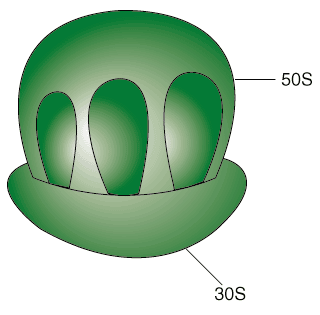
Once the small subunit associates with an mRNA molecule, the two subunits come together, creating a compactor that keeps the mRNA and tRNA in stable and proper orientation for protein synthesis.
If we look at the chemical structure of an amino acid, we see that one end contains a terminal nitrogen group while the other contains a carboxyl group.
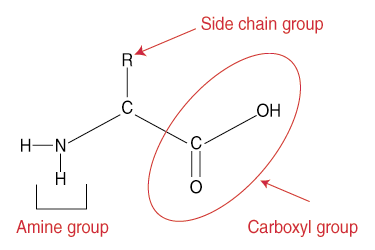
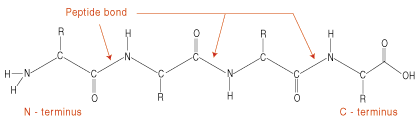
When amino acids are transferred from the aminoacyl tRNA in the A site to the growing protein chain attached to the P site, they are transferred in a specific orientation so that the chain grows by adding amino acids to the carboxyl, not nitrogen, end of the chain. In this way, the protein chain grows in the nitrogen to carboxyl direction. This synthesized chain is called a polypeptide chain. Similarly, each amino acid added can be called a peptide; a building block of the larger polypeptide chain. Proteins are polypeptides.
Please wait while we process your payment