Did you know you can highlight text to take a note?
x

Please wait while we process your payment


If you don't see it, please check your spam folder. Sometimes it can end up there.
If you don't see it, please check your spam folder. Sometimes it can end up there.
Please wait while we process your payment


By signing up you agree to our terms and privacy policy.
Don’t have an account? Subscribe now
Create Your Account
Sign up for your FREE 7-day trial
By signing up you agree to our terms and privacy policy.
Already have an account? Log in
Your Email
Choose Your Plan
Individual
Group Discount
Save over 50% with a SparkNotes PLUS Annual Plan!
 payment page
Purchasing SparkNotes PLUS for a group?
Get Annual Plans at a discount when you buy 2 or more!
Price
$24.99 $18.74 /subscription + tax
Subtotal $37.48 + tax
Save 25% on 2-49 accounts
Save 30% on 50-99 accounts
Want 100 or more? Contact us for a customized plan.
payment page
Your Plan
Payment Details
Payment Summary
SparkNotes Plus
You'll be billed after your free trial ends.
7-Day Free Trial
Not Applicable
Renews May 13, 2025 May 6, 2025
Discounts (applied to next billing)
DUE NOW
US $0.00
SNPLUSROCKS20 | 20% Discount
This is not a valid promo code.
Discount Code (one code per order)
SparkNotes PLUS Annual Plan - Group Discount
Qty: 00
SparkNotes Plus subscription is $4.99/month or $24.99/year as selected above. The free trial period is the first 7 days of your subscription. TO CANCEL YOUR SUBSCRIPTION AND AVOID BEING CHARGED, YOU MUST CANCEL BEFORE THE END OF THE FREE TRIAL PERIOD. You may cancel your subscription on your Subscription and Billing page or contact Customer Support at custserv@bn.com. Your subscription will continue automatically once the free trial period is over. Free trial is available to new customers only.
Choose Your Plan
This site is protected by reCAPTCHA and the Google Privacy Policy and Terms of Service apply.
For the next 7 days, you'll have access to awesome PLUS stuff like AP English test prep, No Fear Shakespeare translations and audio, a note-taking tool, personalized dashboard, & much more!
You’ve successfully purchased a group discount. Your group members can use the joining link below to redeem their group membership. You'll also receive an email with the link.
Members will be prompted to log in or create an account to redeem their group membership.
Thanks for creating a SparkNotes account! Continue to start your free trial.

We're sorry, we could not create your account. SparkNotes PLUS is not available in your country. See what countries we’re in.
There was an error creating your account. Please check your payment details and try again.
Please wait while we process your payment

Your PLUS subscription has expired
Please wait while we process your payment


Please wait while we process your payment
Leaf
Leaves contain chlorophyll and are the sites of photosynthesis in plants. Their broad, flattened surfaces gather energy from sunlight while apertures on the their undersides bring in carbon dioxide and release oxygen. The cells of a leaf are sandwiched in between two layers of epidermal cells, which provide the leaf with a waxy, nearly impermeable cuticle that protects against water loss. The only way for gases to diffuse in and out of the leaf is though small openings on the underside of the leaf, the stomata. These stomata can open and close according to the plant's needs. The tissues of the leaf in between the epidermal cells, into which gases diffuse from the stomata, are called mesophyll.
The mesophyll can be further broken down into two layers, the palisade layer and the spongy layer, both of which are packed with chloroplasts, the factories of photosynthesis. In the palisade layer, chloroplasts are lined in columns just below the epidermal cells, to facilitate the capture of light. The spongy layer is a tissue that also contains chloroplasts and other parenchyma cells, but the cells are less ordered and spread out, leaving large intracellular spaces. These intracellular spaces, along with the moist surface of mesophyll cells, facilitate the exchange of carbon dioxide and oxygen.
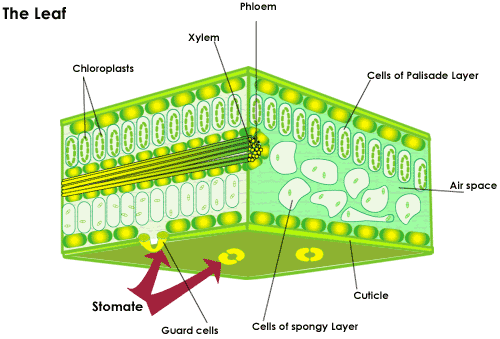
Overall, it is to the plant's advantage to maximize the gas exchange and sunlight trapping surface while keeping leaf thickness to a minimum so that gases can diffuse easily throughout the cells of the leaf (a process that occurs readily only when there are only a few layers of cells present).
Stomata, as mentioned above, are the structures through which gas exchange occurs in leaves. Each stoma is surrounded by two guard cells, which can open and close depending on environmental conditions. When moisture is plentiful, the guard cells swell with water, forcing the opening of the stoma open and allowing gas exchange to occur. When the plant loses too much water or water in the environment becomes less plentiful, the guard cells deflate, closing the stoma and preventing further water loss or gas exchange.
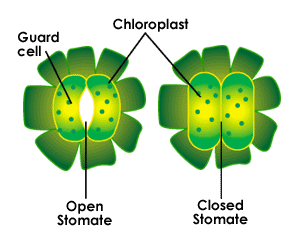
When the stomata are open, the plant can take in carbon dioxide from the air for photosynthesis and release oxygen (a byproduct of photosynthesis) back into the environment. While doing so, the plant also loses an enormous amount of water by evaporation. This process is called transpiration. To make up for this water loss, additional water is drawn in from the soil by the roots and passed upward through the plant by the xylem.
Please wait while we process your payment