Did you know you can highlight text to take a note?
x

Please wait while we process your payment


If you don't see it, please check your spam folder. Sometimes it can end up there.
If you don't see it, please check your spam folder. Sometimes it can end up there.
Please wait while we process your payment


By signing up you agree to our terms and privacy policy.
Don’t have an account? Subscribe now
Create Your Account
Sign up for your FREE 7-day trial
By signing up you agree to our terms and privacy policy.
Already have an account? Log in
Your Email
Choose Your Plan
Individual
Group Discount
Save over 50% with a SparkNotes PLUS Annual Plan!
 payment page
Purchasing SparkNotes PLUS for a group?
Get Annual Plans at a discount when you buy 2 or more!
Price
$24.99 $18.74 /subscription + tax
Subtotal $37.48 + tax
Save 25% on 2-49 accounts
Save 30% on 50-99 accounts
Want 100 or more? Contact us for a customized plan.
payment page
Your Plan
Payment Details
Payment Summary
SparkNotes Plus
You'll be billed after your free trial ends.
7-Day Free Trial
Not Applicable
Renews May 16, 2025 May 9, 2025
Discounts (applied to next billing)
DUE NOW
US $0.00
SNPLUSROCKS20 | 20% Discount
This is not a valid promo code.
Discount Code (one code per order)
SparkNotes PLUS Annual Plan - Group Discount
Qty: 00
SparkNotes Plus subscription is $4.99/month or $24.99/year as selected above. The free trial period is the first 7 days of your subscription. TO CANCEL YOUR SUBSCRIPTION AND AVOID BEING CHARGED, YOU MUST CANCEL BEFORE THE END OF THE FREE TRIAL PERIOD. You may cancel your subscription on your Subscription and Billing page or contact Customer Support at custserv@bn.com. Your subscription will continue automatically once the free trial period is over. Free trial is available to new customers only.
Choose Your Plan
This site is protected by reCAPTCHA and the Google Privacy Policy and Terms of Service apply.
For the next 7 days, you'll have access to awesome PLUS stuff like AP English test prep, No Fear Shakespeare translations and audio, a note-taking tool, personalized dashboard, & much more!
You’ve successfully purchased a group discount. Your group members can use the joining link below to redeem their group membership. You'll also receive an email with the link.
Members will be prompted to log in or create an account to redeem their group membership.
Thanks for creating a SparkNotes account! Continue to start your free trial.

We're sorry, we could not create your account. SparkNotes PLUS is not available in your country. See what countries we’re in.
There was an error creating your account. Please check your payment details and try again.
Please wait while we process your payment

Your PLUS subscription has expired
Please wait while we process your payment


Please wait while we process your payment
Flowers
Flowers, the reproductive structures of angiosperms, are adaptations designed to attract insects and other pollen-bearing animals to the plant to aid in pollen dispersal. For this reason, flowers are most often colorful and showy; not surprisingly, plants that rely on wind (instead of insects) for pollen dispersal have flowers that are more likely to be small and drab. The flower is composed of four whorls of modified leaves, the calyx, corolla, androecium, and gynoecium. Each of these whorls contains one of the flower organs, the sepals, petals, stamens, or pistils, respectively. Sepals and petals are not directly involved in reproduction, while the stamens and pistils are the male and female reproductive organs. In addition, each flower possesses an ovary (at the base of the pistil) formed from modified leaves called carpels (note that the pistil itself is sometimes referred to as the carpel). This ovary, an exclusive feature of angiosperms, encloses the ovules and develops into a fruit after fertilization. For a discussion of angiosperm reproduction, see also Plant Classification, Angiosperms.
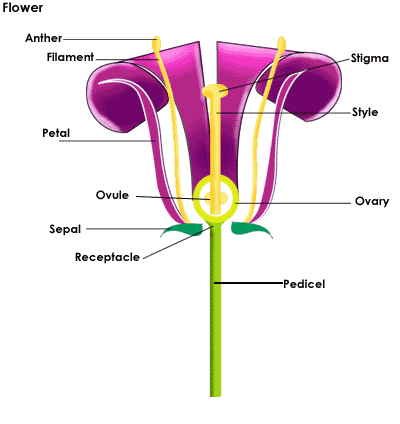
The calyx is made up of sepals, green leaf-like structures that enclose the unopened bud. They serve a protective role for the flower before it opens, and afterward extend from the base of the flower.
The corolla is made up of the petals of the flower, which are usually brightly colored in order to attract insects. Together, the corolla and calyx make up the perianth, the nonreproductive portion of the flower.
The androecium is composed of the male reproductive organs, the stamens. Each stamen consists of a long, slender filament topped by a pollen-producing anther. The anther contains numerous sporangia, which give rise to microspores. These microspores develop, in turn, into pollen grains, which carry sperm cells to the female reproductive organs.
The gynoecium, composed of a pistil or pistils (or carpels, as they are also sometimes called), lies in the very middle of the flower. The top of the pistil, where pollen grains land, is called the stigma and the shaft leading down into the ovary is called the style. The ovary, containing ovules and egg cells, makes up the very bottom of the pistil.
Please wait while we process your payment