





Homonuclear Diatomic Molecules
In atoms, as you know, electrons reside in orbitals of differing energy
levels such as 1s, 2s, 3d, etc.
These orbitals represent the probability distribution for finding an
electron anywhere around the
atom. Molecular orbital theory posits the notion that electrons in
molecules likewise exist in
different orbitals that give the probability of finding the electron at
particular points around the
molecule. To produce the set of orbitals for a molecule, we add
together the valence atomic
wavefunctions for the bonded atoms in the molecule. This is not as complicated
as it may sound. Let's consider the bonding in
homonuclear diatomic
molecules--molecules of the formula A2.
Perhaps the simplest molecule we can imagine is hydrogen, H2.
As we have
discussed, to produce the molecular orbitals for hydrogen, we add together
the valence atomic
wavefunctions to produce the molecular orbitals for hydrogen. Each
hydrogen atom in
H2 has only the 1s orbital, so we add the two 1s
wavefunctions. As you have
learned in your study of atomic structure, atomic wavefunctions can have
either plus or minus
phases--this means the value of the wavefunction y
is either positive or
negative. There are two ways to add the wavefunctions, either
both in-phase (either both
plus or both minus) or out-of-phase (one plus and the other minus).
shows how atomic wavefunctions can be added together to produce molecular
orbitals.
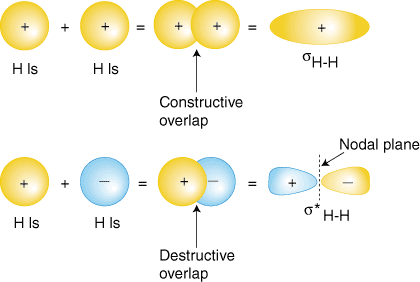
Figure 1.1: Two 1s orbitals combine to form a bonding and an antibonding M.O.
The in-phase overlap combination (top set of orbitals in ) produces a
build-up of electron density between the two nuclei which results in a
lower energy for that orbital.
The electrons occupying the sH-H
orbital represent the
bonding pair of electrons from the Lewis structure of H2 and
is aptly named a
bonding molecular orbital. The other molecular orbital produced, s*H-H shows a decrease in electron
density
between the nuclei
reaching a value of zero at the midpoint between the nuclei where there is
a nodal plane. Since the s*H-H orbital shows a decrease in
bonding
between the two
nuclei, it is called an antibonding molecular orbital. Due to the
decrease in electron density
between the nuclei, the antibonding orbital is higher in energy than both
the bonding orbital and the
hydrogen 1s orbitals. In the molecule H2, no electrons occupy the
antibonding orbital.
To summarize these findings about the relative energies of the bonding,
antibonding, and atomic
orbitals, we can construct an orbital correlation diagram, shown
in :
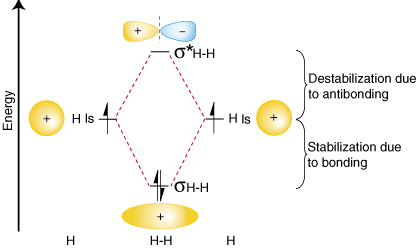
Figure 1.2: An orbital correlation diagram for hydrogen
Notice that the orbitals of the separated atoms are written on either side
of the diagram as horizontal
lines at heights denoting their relative energies. The electrons in each
atomic orbital are represented
by arrows. In the middle of the diagram, the molecular orbitals of the
molecule of interest are
written. Dashed lines connect the parent atomic orbitals with the daughter
molecular orbitals. In
general, bonding molecular orbitals are lower in energy than either of
their parent atomic orbitals.
Similarly, antibonding orbitals are higher in energy than either of its
parent atomic orbitals. Because
we must obey the law of conservation of energy, the amount of stabilization
of the bonding orbital
must equal the amount of destabilization of the antibonding orbital, as shown
above.
You may be wondering whether the Lewis structure and the molecular orbital
treatment of the hydrogen molecule
agree with one another. In fact, they do. The Lewis structure for
H2 is H-H, predicting
a single bond between each hydrogen atom with two electrons in the bond.
The orbital correlation
diagram in predicts the same thing--two electrons
fill a single bonding
molecular orbital. To further demonstrate the consistency of the Lewis
structures with M.O. theory,
we will formalize a definition of bond order--the number of bonds
between atoms in a molecule.
The bond order is the difference in the number of electron pairs occupying
an antibonding and a
bonding molecular orbital. Because hydrogen has one electron pair
in its bonding orbital and
none in its antibonding orbital, molecular orbital theory predicts that H
2 has a bond
order of one--the same result that is derived from Lewis structures.
To demonstrate why it is important to take the number of antibonding
electrons into account in our
bond order calculation, let us consider the possibility of making a
molecule of He2. An
orbital correlation diagram for He2 is provided in :
Figure 1.3: An orbital correlation diagram for a hypothetical He-He molecule
From the orbital correlation diagram above you should
notice that the amount of
stabilization due to bonding is equal to the amount of destabilization due
to antibonding, because there
are two electrons in the bonding orbital and two electrons in the
antibonding orbital. Therefore, there
is no net stabilization due to bonding so the He2 molecule will
not exist. The bond
order calculation shows that there will be a bond order of zero for the
He2 molecule--exactly what we should predict given that helium is a
noble gas and does
not form covalent
compounds.
Both hydrogen and helium only have 1s atomic orbitals so they produce very
simple correlation
diagrams. However, we have already developed the techniques necessary to
draw a correlation
diagram for a more complex homonuclear diatomic like diboron,
B2. Before we can
draw a correlation diagram for B2, we must first find the
in-phase and out-of-phase
overlap combinations for boron's atomic orbitals. Then, we rank them
in order of increasing
energy. Each boron atom has one 2s and three 2p valence orbitals. Due to
the great difference in
energy between the 2s and 2p orbitals, we can ignore the overlap of these
orbitals with each other.
All orbitals composed primarily of the 2s orbitals will be
lower in energy than those
comprised of the 2p orbitals. shows the process of
creating the molecular
orbitals for diboron by combining orbitals of atomic boron. Note that the
orbitals of lowest energy have the most
constructive overlap (fewest
nodes) and the orbitals with the highest energy have the most destructive
overlap (most nodes).
Figure 1.4: The molecular orbitals of diboron
Notice that there are two different kinds of overlap for p-orbitals--end-on
and side-on types of overlap.
For the p-orbitals, there is one end-on overlap possible which occurs
between the two
pz. Two side-on overlaps are possible--one between the two
px and one
between the two p y. P-orbitals overlapping end-on create s bonds. When p-orbitals bond in a side-on fashion,
they create p bonds. The difference between a p bond and a
s bond is the symmetry of the molecular orbital
produced. s bonds are cylindrically symmetric about the bonding
axis, the z-direction.
That means one can rotate the s bond about the
z-axis and the bond
remains the same. In contrast, p bonds lack that
cylindrical symmetry
and have a node passing through the bonding axis.
Now that we have determined the energy levels for B2, let's draw
the orbital correlation
diagram ():
Figure 1.5: Orbital correlation diagram for diboron
The orbital correlation diagram for diboron, however, is not generally
applicable for all homonuclear
diatomic molecules. It turns out that only when the bond lengths are relatively
short (as in B2,
C2, and N2) can the two p-orbitals on the bonded
atoms efficiently
overlap to form a strong p bond. Some textbooks
explain this
observation in terms of a concept called s-p mixing. For any atom with an
atomic number greater
than seven, the p bond is less stable and higher in
energy than is the s bond formed by the two end-on overlapping p orbitals.
Therefore, the
following orbital correlation diagram for fluorine is representative of all
homonuclear
diatomic molecules with atomic numbers greater than seven.
Figure 1.6: Orbital correlation diagram for homonuclear diatomic molecules other
than
B2, C2, and N2
Heteronuclear Diatomic Molecules
To draw the correlation diagrams for heteronuclear diatomic molecules, we face a
new problem: where do we place
the atomic orbitals on an atom relative to atomic orbitals on other atoms? For
example, how
can we predict whether a
fluorine 2s or a lithium 2s orbital is lower in energy? The answer comes
from our understanding of electronegativity. Fluorine is more electronegative
than lithium.
Then electrons are
more stable, i.e. lower in energy, when they are lone pairs on fluorine rather
than on lithium. The more
electronegative element's orbitals are placed lower on the
correlation diagram than those of the
more electropositive element. illustrates this point:
Figure 1.7: Orbital correlation diagram for LiF
Since lithium only has one occupied valence orbital, only one bonding
and one antibonding
orbital are possible. Furthermore, the electrons in orbitals on F that
cannot bond with Li are left on F
as lone pairs. As you can see, the electrons in the Li-F s bond are
quite close in energy to fluorine's 2p orbitals. Then the bonding
orbital is primarily composed
of a fluorine 2p orbital, so the M.O. diagram predicts that the bond should be
polarized toward fluorine--exactly what is found by measuring the bond dipole.
Such an extreme
polarization of electron
density towards fluorine represents a transfer of an electron from lithium
to fluorine and the creation of
an ionic compound.
The construction of other heteronuclear diatomic orbital correlation diagrams
follows exactly the same
principles as those we employed for LiF. To see more examples of such diagrams,
consult your favorite
chemistry textbook.
Bonding in Polyatomic Molecules
As you can imagine, to describe the bonding in polyatomic molecules, we would
need a
molecular orbital
diagram with more than two dimensions so we could describe the bonds both
between the central
atom and each terminal atom and between the terminal atoms themselves.
Such diagrams are
impractically difficult to draw or require complex methods to collapse such
multidimensional figures
into two dimensions. Instead we will describe a simple yet powerful
method to describe the
bonding in polyatomic molecules called hybridization. By adding together
certain atomic orbitals, we can produce a set of hybridized
atomic orbitals that have
the correct shape and directionality to account for the known bond angles
in polyatomic molecules.
Hybrid orbitals describe the bonding in polyatomic molecules one bond at a
time.
From the geometry of the molecules, as predicted by VSEPR, we can
deduce the hybridization
of the central atom. Linear molecules are sp hybridized. Each hybrid orbital
is composed of a combination of an s and a p orbital on the central atom. The
other
geometries are produced by the
proper mixture of atomic orbitals. Molecules based on a triangle are
sp2 hybridized.
Tetrahedrally based molecules are sp3 hybridized. Trigonal
bipyramidally based
molecules are dsp3 hybridized. Octahedrally based molecules are
d2sp3 hybridized.
To illustrate how hybrid orbitals are used to describe the bonding in
polyatomic molecules, we will
examine the bonds that form water, H2O. Water is
AB2e2,
therefore, its geometry is based on a tetrahedron, and it is
sp3 hybridized. Two
sp3 hybrid orbitals on oxygen with one electron each can form a
bond with the singly
occupied 1s orbitals on the hydrogen atoms. The remaining two
sp3 hybrid orbitals on
oxygen each have two electrons in them and are, therefore, lone pairs. A
model of the bonding in
water is shown in :
Figure 1.8: The bonding in water
To produce hybrid bonding descriptions of any compound, first decide what is the
hybridization of the
central atom based on its geometry. Next, form bonds between the
hybrid or atomic orbitals on
terminal atoms and the central atom. Finally, check to make sure that your
bonding description
agrees with the Lewis structure in the number of bonds formed and the
number of lone pairs.









