






 Ad-free experience
 Study Guides for 1,000+ titles
 Full Text content for 250+ titles
 No Fear Translations of Shakespeare’s plays (along with audio!) and other classic works
 Flashcards
 Mastery Quizzes
 Infographics
 Graphic Novels
 AP® Practice & Lessons
 Note-taking
 Bookmarking
 Dashboard









The Gross Domestic Product measures the value of economic activity within a country. Strictly defined, GDP is the sum of the market values, or prices, of all final goods and services produced in an economy during a period of time. There are, however, three important distinctions within this seemingly simple definition:
- GDP is a number that expresses the worth of the output of a country in local currency.
- GDP tries to capture all final goods and services as long as they are produced within the country, thereby assuring that the final monetary value of everything that is created in a country is represented in the GDP.
- GDP is calculated for a specific period of time, usually a year or a quarter of a year.
Computing GDP
Now that we have an idea of what GDP is, let's go over how to compute it. We
know that in an economy, GDP is the monetary value of all final goods and
services produced. For example, let's say Country B only produces bananas and
backrubs.
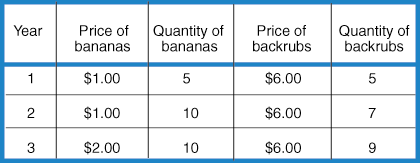
In the real world, the market values of many goods and services must be calculated to determine GDP. While the total output of GDP is important, the breakdown of this output into the large structures of the economy can often be just as important. In general, macroeconomists use a standard set of categories to breakdown an economy into its major constituent parts; in these instances, GDP is the sum of consumer spending, investment, government purchases, and net exports, as represented by the equation:
Y = C + I + G + NXBecause in this equation Y captures every segment of the national economy, Y represents both GDP and the national income. This because when money changes hands, it is expenditure for one party and income for the other, and Y, capturing all these values, thus represents the net of the entire economy.
Let's briefly examine each of the components of GDP.
- Consumer spending, C, is the sum of expenditures by households on durable goods, nondurable goods, and services. Examples include clothing, food, and health care.
- Investment, I, is the sum of expenditures on capital equipment, inventories, and structures. Examples include machinery, unsold products, and housing.
- Government spending, G, is the sum of expenditures by all government bodies on goods and services. Examples include naval ships and salaries to government employees.
- Net exports, NX, equals the difference between spending on domestic goods by foreigners and spending on foreign goods by domestic residents. In other words, net exports describes the difference between exports and imports.
GDP vs. GNP
GDP is just one way of measuring the total output of an economy. Gross National Product, or GNP, is another method. GDP, as said earlier, is the sum value of all goods and services produced within a country. GNP narrows this definition a bit: it is the sum value of all goods and services produced by permanent residents of a country regardless of their location. The important distinction between GDP and GNP rests on differences in counting production by foreigners in a country and by nationals outside of a country. For the GDP of a particular country, production by foreigners within that country is counted and production by nationals outside of that country is not counted. For GNP, production by foreigners within a particular country is not counted and production by nationals outside of that country is counted. Thus, while GDP is the value of goods and services produced within a country, GNP is the value of goods and services produced by citizens of a country.
For example, in Country B, represented in , bananas are produced by nationals and backrubs are produced by foreigners. Using figure 1, GDP for Country B in year 1 is (5 X $1) + (5 X $6) = $35. GNP for country B is (5 X $1) = $5, since the $30 from backrubs is added to the GNP of the foreigners' country of origin.
The distinction between GDP and GNP is theoretically important, but not often practically consequential. Since the majority of production within a country is by nationals within that country, GDP and GNP are usually very close together. In general, macroeconomists rely on GDP as the measure of a country's total output.
Growth Rate of GDP
GDP is an excellent index with which to compare the economy at two points in time. That comparison can then be used formulate the growth rate of total output within a nation.
In order to calculate the GDP growth rate, subtract 1 from the value received by dividing the GDP for the first year by the GDP for the second year.
GDP growth rate = [(GDP1)/(GDP2] - 1For example, using , in year 1 Country B produced 5 bananas worth $1 each and 5 backrubs worth $6 each. In year 2 Country B produced 10 bananas worth $1 each and 7 backrubs worth $6 each. In this case the GDP growth rate from year 1 to year 2 would be:
[(10 X $1) + (7 X $6)] / [(5 X $1) + (5 X $6)] - 1 = 49%
There is an obvious problem with this method of computing growth in total output: both increases in the price of goods produced and increases in the quantity of goods produced lead to increases in GDP. From the GDP growth rate it is therefore difficult to determine if it is the amount of output that is changing or if it is the price of output undergoing change.
This limitation means that an increase in GDP does not necessarily imply that an economy is growing. If, for example, Country B produced in one year 5 bananas each worth $1 and 5 backrubs each worth $6, then the GDP would be $35. If in the next year the price of bananas jumps to $2 and the quantities produced remain the same, then the GDP of Country B would be $40. While the market value of the goods and services produced by Country B increased, the amount of goods and services produced did not. This problem can make comparison of GDP from one year to the next difficult as changes in GDP are not necessarily due to economic growth.
Real GDP vs. Nominal GDP
In order to deal with the ambiguity inherent in the growth rate of GDP, macroeconomists have created two different types of GDP, nominal GDP and real GDP.
- Nominal GDP is the sum value of all produced goods and services at current prices. This is the GDP that is explained in the sections above. Nominal GDP is more useful than real GDP when comparing sheer output, rather than the value of output, over time.
- Real GDP is the sum value of all produced goods and services at constant prices. The prices used in the computation of real GDP are gleaned from a specified base year. By keeping the prices constant in the computation of real GDP, it is possible to compare the economic growth from one year to the next in terms of production of goods and services rather than the market value of these goods and services. In this way, real GDP frees year-to-year comparisons of output from the effects of changes in the price level.
The first step to calculating real GDP is choosing a base year. For example, to calculate the real GDP for in year 3 using year 1 as the base year, use the GDP equation with year 3 quantities and year 1 prices. In this case, real GDP is (10 X $1) + (9 X $6) = $64. For comparison, the nominal GDP in year 3 is (10 X $2) + (9 X $6) = $74. Because the price of bananas increased from year 1 to year 3, the nominal GDP increased more than the real GDP over this time period.
GDP Deflator
When comparing GDP between years, nominal GDP and real GDP capture different elements of the change. Nominal GDP captures both changes in quantity and changes in prices. Real GDP, on the other hand, captures only changes in quantity and is insensitive to the price level. Because of this difference, after computing nominal GDP and real GDP a third useful statistic can be computed. The GDP deflator is the ratio of nominal GDP to real GDP for a given year minus 1. In effect, the GDP deflator illustrates how much of the change in the GDP from a base year is reliant on changes in the price level.
For example, let's calculate, using , the GDP deflator for Country B in year 3, using year 1 as the base year. In order to find the GDP deflator, we first must determine both nominal GDP and real GDP in year 3.
Nominal GDP in year 3 = (10 X $2) + (9 X $6) = $74This means that the price level rose 16% from year 1, the base year, to year 3, the comparison year.
Real GDP in year 3 (with year 1 as base year) = (10 X $1) + (9 X $6) = $64
The ratio of nominal GDP to real GDP is ( $74 / $64 ) - 1 = 16%.
Rearranging the terms in the equation for the GDP deflator allows for the calculation of nominal GDP by multiplying real GDP and the GDP deflator. This equation demonstrates the unique information shown by each of these measures of output. Real GDP captures changes in quantities. The GDP deflator captures changes in the price level. Nominal GDP captures both changes in prices and changes in quantities. By using nominal GDP, real GDP, and the GDP deflator you can look at a change in GDP and break it down into its component change in price level and change in quantities produced.
GDP Per Capita
GDP is the single most useful number when describing the size and growth of a country's economy. An important thing to consider, though, is how GDP is connected with standard of living. After all, to the citizens of a country, the economy itself is less important than the standard of living that it provides.
GDP per capita, the GDP divided by the size of the population, gives the amount of GDP that each individual gets, on average, and thereby provides an excellent measure of standard of living within an economy. Because GDP is equal to national income, the value of GDP per capita is therefore the income of a representative individual. This number is connected directly to standard of living. In general, the higher GDP per capita in a country, the higher the standard of living.
GDP per capita is a more useful measure than GDP for determining standard of living because of differences in population across countries. If a country has a large GDP and a very large population, each person in the country may have a low income and thus may live in poor conditions. On the other hand, a country may have a moderate GDP but a very small population and thus a high individual income. Using the GDP per capita measure to compare standard of living across countries avoids the problem of division of GDP among the inhabitants of a country.



