Ad-free experience
 Study Guides for 1,000+ titles
 Full Text content for 250+ titles
 No Fear Translations of Shakespeare’s plays (along with audio!) and other classic works
 Flashcards
 Mastery Quizzes
 Infographics
 Graphic Novels
 AP® Practice & Lessons
 Note-taking
 Bookmarking
 Dashboard









Theoretically, if left alone, a market will naturally settle into equilibrium: the equilibrium price ensures that all sellers who are willing to sell at that price, and all buyers who are willing to buy at that price will get what they want. At equilibrium, supply is exactly equal to demand. However, in some cases, the government will interfere with the market, putting in price ceilings or price floors, charging taxes, or using other measures to reshape the economy.
Price Ceilings
A price ceiling is an upper limit for the price of a good: once a price ceiling has been put in, sellers cannot charge more than that. In most cases, price ceilings are below market price. If a price ceiling is set at or above market price, there will be no noticeable effect, and the ceiling is only a preventative measure. If the ceiling is set below market price, however, there will be a shortage of goods. For instance, if the government thinks 1) that people need bread to live, and 2) that the market price of bread is too high, then they might install a price ceiling. Assume that the following graph represents the market for bread. At equilibrium, the price will be p*, and the quantity will be q*.
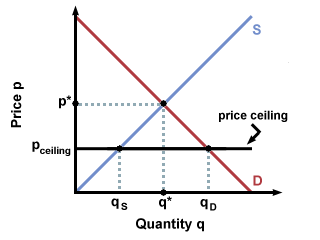
If the government puts in a price ceiling, we can see that the quantity demanded will exceed the quantity supplied, meaning that not enough bread will be supplied to satisfy demand. Such a situation is called a shortage. Because price ceilings are installed in the interests of the buyers, the government has to decide which situation is preferable for the buyers: not being able to afford any bread, or not having enough bread to go around.
Price Floors
The opposite of a price ceiling is a price floor. A price floor is an
artificially introduced minimum for the price of a good. In most cases, the
price floor is above the market price. Price floors are usually put in to
benefit sellers. For example, price floors are sometimes used for agricultural
products. The market price can sometimes be so low that farmers cannot make
enough money to support themselves. In such cases, the government steps in and
sets a price floor, which can cause problems of its own:

Taxes
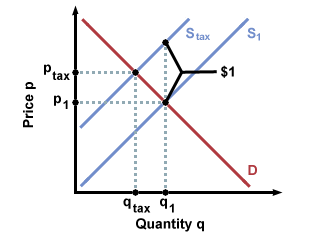
Another way in which the government can alter the market is through taxes. One such example is in the tobacco market: if the government would like to discourage the sale and use of tobacco, they would charge tobacco sellers a tax on tobacco products. In most cases, sellers pass as much of the added cost on to buyers as possible. Because the sellers don't want to lose any profits, they have to increase their selling price in order to maintain the same profit margin, since they had to pay an extra tax when obtaining the products for resale. In such cases, the supply curve will shift vertically by the exact amount of the tax.
So, if the government charges a $1 tax on every pack of cigarettes, and the cigarette sellers want to pass this tax on to the buyers, then the supply curve will shift upwards by $1. (Note that the $1 shift is the vertical distance between the pre-tax and post-tax curves). The net result is that for any price, the stores will sell fewer packs of cigarettes, to make up for the extra cost of the tax. In effect, if consumers want to maintain their previous levels of consumption, cigarettes would now cost $1 more per pack. However, the new equilibrium shows that prices will be in between p and (p+1), and the new quantity will be less than the initial quantity. We can see how this works on the graph below.