Did you know you can highlight text to take a note?
x

Please wait while we process your payment


If you don't see it, please check your spam folder. Sometimes it can end up there.
If you don't see it, please check your spam folder. Sometimes it can end up there.
Please wait while we process your payment


By signing up you agree to our terms and privacy policy.
Don’t have an account? Subscribe now
Create Your Account
Sign up for your FREE 7-day trial
By signing up you agree to our terms and privacy policy.
Already have an account? Log in
Your Email
Choose Your Plan
Individual
Group Discount
Save over 50% with a SparkNotes PLUS Annual Plan!
 payment page
Purchasing SparkNotes PLUS for a group?
Get Annual Plans at a discount when you buy 2 or more!
Price
$24.99 $18.74 /subscription + tax
Subtotal $37.48 + tax
Save 25% on 2-49 accounts
Save 30% on 50-99 accounts
Want 100 or more? Contact us for a customized plan.
payment page
Your Plan
Payment Details
Payment Summary
SparkNotes Plus
You'll be billed after your free trial ends.
7-Day Free Trial
Not Applicable
Renews July 8, 2025 July 1, 2025
Discounts (applied to next billing)
DUE NOW
US $0.00
SNPLUSROCKS20 | 20% Discount
This is not a valid promo code.
Discount Code (one code per order)
SparkNotes PLUS Annual Plan - Group Discount
Qty: 00
SparkNotes Plus subscription is $4.99/month or $24.99/year as selected above. The free trial period is the first 7 days of your subscription. TO CANCEL YOUR SUBSCRIPTION AND AVOID BEING CHARGED, YOU MUST CANCEL BEFORE THE END OF THE FREE TRIAL PERIOD. You may cancel your subscription on your Subscription and Billing page or contact Customer Support at custserv@bn.com. Your subscription will continue automatically once the free trial period is over. Free trial is available to new customers only.
Choose Your Plan
This site is protected by reCAPTCHA and the Google Privacy Policy and Terms of Service apply.
For the next 7 days, you'll have access to awesome PLUS stuff like AP English test prep, No Fear Shakespeare translations and audio, a note-taking tool, personalized dashboard, & much more!
You’ve successfully purchased a group discount. Your group members can use the joining link below to redeem their group membership. You'll also receive an email with the link.
Members will be prompted to log in or create an account to redeem their group membership.
Thanks for creating a SparkNotes account! Continue to start your free trial.

We're sorry, we could not create your account. SparkNotes PLUS is not available in your country. See what countries we’re in.
There was an error creating your account. Please check your payment details and try again.
Please wait while we process your payment

Your PLUS subscription has expired
Please wait while we process your payment


Please wait while we process your payment
Volumes of Solids
The application of integrals to the computation of areas in the plane can be extended to the computation of certain volumes in space, namely those of solids of revolution. A solid of revolution arises from revolving the region below the graph of a function f (x) about the x- or y-axis of the plane. A cone arises in this way from a triangular region, a sphere from a semicircular region, and a cylinder from a rectangular region. These are just a few of the possibilities for solids of revolution.
There are two primary methods for finding the volume of a solid of revolution. The shell method is applied to a solid obtained by revolving the region below the graph of a function f (x) from a to b about the y-axis. It approximates the solid with a number of thin cylindrical shells, obtained by revolving about the y-axis the thin rectangular regions used to approximate the corresponding region in the plane. This is illustrated in the figure below.
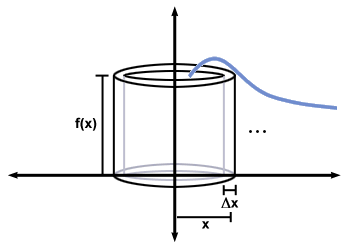
The volume of a thin cylindrical shell of radius x, thickness Δx, and height f (x) is equal to
Π(x +  )2f (x) - Π(x - )2f (x) )2f (x) - Π(x - )2f (x) | = | Π(2xΔx)f (x) | |
| = | (2Πx)(Δxf (x)) |
Here by "cylindrical shell" we mean the region between two concentric cylinders whose radii differ only very slightly; precisely speaking, this formula is not correct for any positive thickness, but approaches the correct value as the thickness Δx shrinks to zero. Since we will ultimately consider such a limit, this formula will yield the correct volume in our application.
If we sum together the volumes of a family of such cylindrical shells, covering the entire interval from a to b, and take the limit as Δx→ 0 (and consequently as the number of cylindrical shells approaches infinity), we end up with the integral
Vol =  2Πxf (x)dx = 2Πxf (x)dx 2Πxf (x)dx = 2Πxf (x)dx |
The disk method for finding volumes applies to a solid obtained by revolving the region below the graph of a function f (x) from a to b about the x-axis. Here the solid is approximated by a number of very thin disks, standing sideways with the x-axis through their centers. These disks are obtained by revolving about the x-axis the thin rectangular regions used to approximate the area of the corresponding region in the plane. This is illustrated in the figure below.
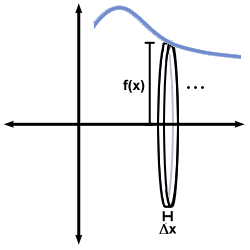
The volume of such a disk is (exactly) the area of the base times the height; hence, if the corresponding rectangle has width Δx and height f (x), the volume is equal to Πf (x)2Δx. Taking the sum of the volumes of all the disks (covering the entire interval from a to b) and taking the limit as Δx→ 0 gives the integral
| Vol = Πf (x)2dx = Πf (x)2dx |
The disk method is a special case of a more general method called the cross-sectional area method. In the disc method, the quantity we end up integrating, from a to b, is Πf (x)2, the cross-sectional area of the solid when sliced by a plane through x perpendicular to the x-axis. Even when the cross-section is not a disk (as it is in the case of more general solids of revolution), there may still be a function A(x) that gives the area of the cross section obtained by slicing the solid with the plane through x and perpendicular to the x-axis. The volume of the solid is then given by
| Vol = A(x)dx |
Please wait while we process your payment