Did you know you can highlight text to take a note?
x

Please wait while we process your payment


If you don't see it, please check your spam folder. Sometimes it can end up there.
If you don't see it, please check your spam folder. Sometimes it can end up there.
Please wait while we process your payment
Get instant, ad-free access to our grade-boosting study tools with a 7-day free trial!
Learn more


Create Account
Select Plan
Payment Info
Start 7-Day Free Trial!
Create Account
This site is protected by reCAPTCHA and the Google Privacy Policy and Terms of Service apply.
Log into your PLUS account
Create Account
Select Plan
Payment Info
Start 7-Day Free Trial!
Select Your Plan
Monthly
$5.99
/month + tax
Annual
$29.99
/year + taxAnnual
2-49 accounts
$22.49/year + tax
50-99 accounts
$20.99/year + tax
Select Quantity
Price per seat
$29.99 $--.--
Subtotal
$-.--
Want 100 or more? Request a customized plan
Monthly
$5.99
/month + taxYou could save over 50%
by choosing an Annual Plan!

Annual
$29.99
/year + taxSAVE OVER 50%
compared to the monthly price!
| Focused-studying | ||
 Ad-free experience Ad-free experience |
 |
|
 Study Guides for 1,000+ titles Study Guides for 1,000+ titles |
|
|
 Full Text content for 250+ titles Full Text content for 250+ titles |
|
|
| PLUS Study Tools | ||
 No Fear Translations of Shakespeare’s plays (along with audio!) and other classic works No Fear Translations of Shakespeare’s plays (along with audio!) and other classic works |
|
|
 Flashcards Flashcards |
|
|
 Mastery Quizzes Mastery Quizzes |
|
|
 Infographics Infographics |
|
|
 Graphic Novels Graphic Novels |
|
|
| AP® Test Prep PLUS | ||
 AP® Practice & Lessons AP® Practice & Lessons |
|
|
| My PLUS Activity | ||
 Note-taking Note-taking |
|
|
 Bookmarking Bookmarking |
|
|
 Dashboard Dashboard |
|
|
Annual
$22.49/month + tax
Save 25%
on 2-49 accounts
Annual
$20.99/month + tax
Save 30%
on 50-99 accounts
| Focused-studying | ||
| Ad-free experience |
|
|
| Study Guides for 1,000+ titles |
|
|
| Full Text content for 250+ titles |
|
|
| PLUS Study Tools | ||
| No Fear Translations of Shakespeare’s plays (along with audio!) and other classic works |
|
|
| Flashcards |
|
|
| Mastery Quizzes |
|
|
| Infographics |
|
|
| Graphic Novels |
|
|
| AP® Test Prep PLUS | ||
| AP® Practice & Lessons |
|
|
| My PLUS Activity | ||
| Note-taking |
|
|
| Bookmarking |
|
|
| Dashboard |
|
|
Testimonials from SparkNotes Customers

No Fear provides access to Shakespeare for students who normally couldn’t (or wouldn’t) read his plays. It’s also a very useful tool when trying to explain Shakespeare’s wordplay!

Erika M.
I tutor high school students in a variety of subjects. Having access to the literature translations helps me to stay informed about the various assignments. Your summaries and translations are invaluable.

Kathy B.
Teaching Shakespeare to today's generation can be challenging. No Fear helps a ton with understanding the crux of the text.

Kay H.
Testimonials from SparkNotes Customers
No Fear provides access to Shakespeare for students who normally couldn’t (or wouldn’t) read his plays. It’s also a very useful tool when trying to explain Shakespeare’s wordplay!
Erika M.
I tutor high school students in a variety of subjects. Having access to the literature translations helps me to stay informed about the various assignments. Your summaries and translations are invaluable.
Kathy B.
Teaching Shakespeare to today's generation can be challenging. No Fear helps a ton with understanding the crux of the text.
Kay H.
Create Account
Select Plan
Payment Info
Start 7-Day Free Trial!
Payment Information
You will only be charged after the completion of the 7-day free trial.
If you cancel your account before the free trial is over, you will not be charged.
You will only be charged after the completion of the 7-day free trial. If you cancel your account before the free trial is over, you will not be charged.
Order Summary
Annual
7-day Free Trial
SparkNotes PLUS
$29.99 / year
Annual
Quantity
51
PLUS Group Discount
$29.99 $29.99 / seat
Tax
$0.00
SPARK25
-$1.25
25% Off
Total billed on Nov 7, 2024 after 7-day free trail
$29.99
Total billed
$0.00
Due Today
$0.00
Promo code
This is not a valid promo code
Card Details
By placing your order, you confirm that you have read the Privacy Policy and Kids’ Privacy Notice and agree to the Terms of Service.
By saving your payment information you allow SparkNotes to charge you for future payments in accordance with their terms.
Powered by stripe
Legal
Google pay.......



Thank You!
Your group members can use the joining link below to redeem their membership. They will be prompted to log into an existing account or to create a new account. All members under 16 will be required to obtain a parent's consent sent via link in an email.Your Child’s Free Trial Starts Now!
Thank you for completing the sign-up process. Your child’s SparkNotes PLUS login credentials are [email] and the associated password. If you have any questions, please visit our help center.Your Free Trial Starts Now!
Please wait while we process your payment

Are you sure? You won't be able to sign up for PLUS without your parent's consent.
Sorry, you must enter a valid email address
By entering an email, I confirm that I or my legal guardian has read the Privacy Policy and Kids’ Privacy Notice and agrees to the Terms of Service.
Please wait while we process your payment
Sorry, you must enter a valid email address
By entering an email, I confirm that I or my legal guardian has read the Privacy Policy and Kids’ Privacy Notice and agrees to the Terms of Service.
Please wait while we process your payment

Your PLUS subscription has expired
Please wait while we process your payment


Please wait while we process your payment
Problems on Refraction 2
Problem :
As light moves from air (n 1.00) to amber it deviates 18o from its 45o angle of
incidence. Which way does it bend? What is the speed of light in amber?
1.00) to amber it deviates 18o from its 45o angle of
incidence. Which way does it bend? What is the speed of light in amber?
 1.56.
The speed in amber is given by v = c/n = 3.0×10⁸/1.56 1.92×10⁸ m/s or 0.64c.
1.56.
The speed in amber is given by v = c/n = 3.0×10⁸/1.56 1.92×10⁸ m/s or 0.64c.
Problem : A transparent fiber of index of refraction 1.6 is surrounded (cladded) by a less dense plastic of index 1.5. At what angle must a light ray in the fiber approach the interface so as to remain within the fiber?
This problem involves total internal reflection. The critical angle for staying within the fiber is given by: sinθc = = 1.5/1.6 = 0.938. Thus θc = 69.6o. The ray must
approach the interface between the media at an angle of 69.6o or greater to the normal.
= 1.5/1.6 = 0.938. Thus θc = 69.6o. The ray must
approach the interface between the media at an angle of 69.6o or greater to the normal.
Problem :
A light ray in air approaches a water surface (n 1.33) such that its electric vector is parallel to the
plane of incidence. If θi = 53.06o, what is the relative amplitude of the reflected beam? What
about if the electric field is perpendicular to the plane of incidence?
r || =   0 0 |
râä¥ =  = - 0.278 = - 0.278 |
0.08, or about
8% as bright as the incident ray (irradiance is proportional to the square of the amplitude).
Problem : By what angle do blue light (λb = 460 nm) and red light (λr = 680 nm) disperse upon entering (from vacuum) a medium with N = 7×1038, ε = 1.94, and σ0 = 5.4×10¹⁵ Hz at an incident angle of 20o (the electron charge is 1.6×10⁻¹⁹ Coulombs and its mass is 9.11×10⁻³¹ kilograms)?
First we must calculate the index of refraction for both light frequencies. The angular frequency of the blue light is σb = 4.10×10¹⁵Hz and for the red light σr = 2.77×10¹⁵. Thus we have:nr2 = 1 +  = 1 + = 1 +  = 1 + 0.472 = 1 + 0.472 |
nb2 = 1 +  = 1 + = 1 +  = 1 + 0.821 = 1 + 0.821 |
Problem : What is the rate of change of the speed of light with angular frequency in a dielectric medium?
We want . But v = c/n. So since c is a constant, we can say = c


 . Now:
 = = 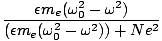 | |||
âá’1n = 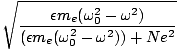 |
 = =   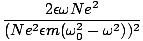   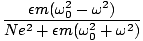  |
 = =  |
Please wait while we process your payment



