payment page



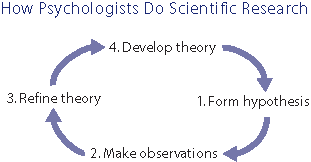
Psychologists use the scientific method to conduct their research. The scientific method is a standardized way of making observations, gathering data, forming theories, testing predictions, and interpreting results.
Researchers make observations in order to describe and measure behavior. After observing certain events repeatedly, researchers come up with a theory that explains these observations. A theory is an explanation that organizes separate pieces of information in a coherent way. Researchers generally develop a theory only after they have collected a lot of evidence and made sure their research results can be reproduced by others.
Example: A psychologist observes that some college sophomores date a lot, while others do not. He observes that some sophomores have blond hair, while others have brown hair. He also observes that in most sophomore couples at least one person has brown hair. In addition, he notices that most of his brown-haired friends date regularly, but his blond friends don’t date much at all. He explains these observations by theorizing that brown-haired sophomores are more likely to date than those who have blond hair. Based on this theory, he develops a hypothesis that more brown-haired sophomores than blond sophomores will make dates with people they meet at a party. He then conducts an experiment to test his hypothesis. In his experiment, he has twenty people go to a party, ten with blond hair and ten with brown hair. He makes observations and gathers data by watching what happens at the party and counting how many people of each hair color actually make dates. If, contrary to his hypothesis, the blond-haired people make more dates, he’ll have to think about why this occurred and revise his theory and hypothesis. If the data he collects from further experiments still do not support the hypothesis, he’ll have to reject his theory.
Making Research Scientific
Psychological research, like research in other fields, must meet certain criteria in order to be considered scientific. Research must be:
- Replicable
- Falsifiable
- Precise
- Parsimonious
Research Must Be Replicable
Research is replicable when others can repeat it and get the same results. When psychologists report what they have found through their research, they also describe in detail how they made their discoveries. This way, other psychologists can repeat the research to see if they can replicate the findings.
After psychologists do their research and make sure it’s replicable, they develop a theory and translate the theory into a precise hypothesis. A hypothesis is a testable prediction of what will happen given a certain set of conditions. Psychologists test a hypothesis by using a specific research method, such as naturalistic observation, a case study, a survey, or an experiment. If the test does not confirm the hypothesis, the psychologist revises or rejects the original theory.
A Good Theory
A good theory must do two things: organize many observations in a logical way and allow researchers to come up with clear predictions to check the theory.
Research Must Be Falsifiable
A good theory or hypothesis also must be falsifiable, which means that it must be stated in a way that makes it possible to reject it. In other words, we have to be able to prove a theory or hypothesis wrong. Theories and hypotheses need to be falsifiable because all researchers can succumb to the confirmation bias. Researchers who display confirmation bias look for and accept evidence that supports what they want to believe and ignore or reject evidence that refutes their beliefs.
Example: Some people theorize that the Loch Ness Monster not only exists but has become intelligent enough to elude detection by hiding in undiscovered, undetectable, underwater caves. This theory is not falsifiable. Researchers can never find these undiscovered caves or the monster that supposedly hides in them, and they have no way to prove this theory wrong.
Research Must Be Precise
By stating hypotheses precisely, psychologists ensure that they can replicate their own and others’ research. To make hypotheses more precise, psychologists use operational definitions to define the variables they study. Operational definitions state exactly how a variable will be measured.
Example: A psychologist conducts an experiment to find out whether toddlers are happier in warm weather or cool weather. She needs to have an operational definition of happiness so that she can measure precisely how happy the toddlers are. She might operationally define happiness as “the number of smiles per hour.”
Research Must Be Parsimonious
The principle of parsimony, also called Occam’s razor, maintains that researchers should apply the simplest explanation possible to any set of observations. For instance, psychologists try to explain results by using well-accepted theories instead of elaborate new hypotheses. Parsimony prevents psychologists from inventing and pursuing outlandish theories.
Parsimony
Parsimonious means “being thrifty or stingy.” A person who values parsimony will apply the thriftiest or most logically economical explanation for a set of phenomena.
Example: Suppose a student consistently falls asleep in her statistics class. She theorizes that before each class, her statistics professor secretly sprays her seat with a nerve gas that makes her very drowsy. If she had applied the principle of parsimony, she would not have come up with this theory. She can account for her sleepiness with a much simpler and more likely explanation: she finds statistics boring.