Ad-free experience
 Study Guides for 1,000+ titles
 Full Text content for 250+ titles
 No Fear Translations of Shakespeare’s plays (along with audio!) and other classic works
 Flashcards
 Mastery Quizzes
 Infographics
 Graphic Novels
 AP® Practice & Lessons
 Note-taking
 Bookmarking
 Dashboard











Key Stimuli
Certain innate behaviors can be produced in all individuals of the same species. Usually, these behaviors are triggered by a key stimulus (KS). The key stimulus triggers an innate releasing mechanism (IRM), a sort of middleman, which produces a fixed action pattern (FAP), a definite, constant response. The IRM can be any visual, hormonal, or muscular mechanism that results in the FAP. An important feature of the FAP is that once started it cannot be stopped until the entire action sequence is completed.
An example of an innate behavior can be seen in Herring gull chicks, which were studied by Tinbergen. Adult females have a red spot on their beak. Chicks instinctually peck at this spot, which stimulates the female to regurgitate and feed the young chick. The red spot is the KS, and it releases the pecking FAP in the chick.
A given KS can be important in triggering several different FAPs. The red bellies of male stickleback fish are one well-studied example. In these fish, males defend territories by attacking invading males. The males position themselves vertically to assume an aggressive posture, displaying their bright red bellies to their opponents. The red belly is the KS for aggressive behavior. Male sticklebacks become enraged by the red color of the belly, though the shape and size are not important. However the red belly also acts as the KS in another reaction. The swollen, red belly stimulates a female stickleback to lay her eggs in the male's nest and then leave the area. In this case, it is the swollen belly and the zigzag dance of the male rather than the fact that his belly is red which stimulates her.
Key stimuli also come in different strengths. Supernormal releasers are exaggerated stimuli that produce a stronger response. Herring gulls, when presented with a model egg twice their body size will actually try to climb up on top of the egg to incubate it. Male sticklebacks have been known to chase ambulances down streams that are next to roads. The ambulance is like a giant red belly to these fish. Human beings are not immune to such sensationalism. People are drawn to the pictures of male and female supermodels who generally look far different from the average person.
Configurational Key Stimuli
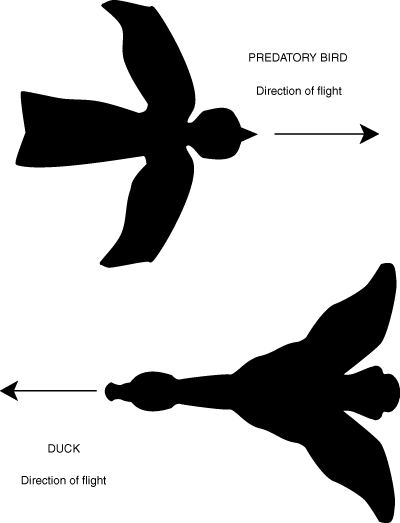
Key stimuli need not come from a single source. Configurational key stimuli are key stimuli made up of multiple KS that together produce a response. An example comes from Tinbergen's study of ducks. Ducklings crouch when predatory birds fly overhead, but not when other ducks pass. As you can see in , predatory birds and ducks have the same general body shape, but the positions of the head and tail are reversed. In order to distinguish between predators and conspecifics, a duckling may use a combination of two key stimuli, the body shape of the predator and the direction of flight. A predatory bird looks like a duckl flying backwards but ducklings do not crouch when ducks fly overhead, possibly because of the reversed direction. An alternate possibility is that ducklings are born to instinctively crouch at everything, and learn not to react to the frequent overhead passes by ducks (again by recognizing both shape and direction), but retain crouching in response to predatory birds.
Search Images
Search images are KS specifically used to find resources, including food. For instance, ticks often use butyric acid, a scent molecule that all mammals produce, to locate a nice furry resting place. Ticks will wait in bushes or trees until a mammal passes by and drop off the leaf onto the mammal. They then use thermosensory methods to seek the warmest place to bite.