Did you know you can highlight text to take a note?
x

Please wait while we process your payment


If you don't see it, please check your spam folder. Sometimes it can end up there.
If you don't see it, please check your spam folder. Sometimes it can end up there.
Please wait while we process your payment
Get instant, ad-free access to our grade-boosting study tools with a 7-day free trial!
Learn more


Create Account
Select Plan
Payment Info
Start 7-Day Free Trial!
Create Account
This site is protected by reCAPTCHA and the Google Privacy Policy and Terms of Service apply.
Log into your PLUS account
Create Account
Select Plan
Payment Info
Start 7-Day Free Trial!
Select Your Plan
Monthly
$5.99
/month + tax
Annual
$29.99
/year + taxAnnual
2-49 accounts
$22.49/year + tax
50-99 accounts
$20.99/year + tax
Select Quantity
Price per seat
$29.99 $--.--
Subtotal
$-.--
Want 100 or more? Request a customized plan
Monthly
$5.99
/month + taxYou could save over 50%
by choosing an Annual Plan!

Annual
$29.99
/year + taxSAVE OVER 50%
compared to the monthly price!
| Focused-studying | ||
 Ad-free experience Ad-free experience |
 |
|
 Study Guides for 1,000+ titles Study Guides for 1,000+ titles |
|
|
 Full Text content for 250+ titles Full Text content for 250+ titles |
|
|
| PLUS Study Tools | ||
 No Fear Translations of Shakespeare’s plays (along with audio!) and other classic works No Fear Translations of Shakespeare’s plays (along with audio!) and other classic works |
|
|
 Flashcards Flashcards |
|
|
 Mastery Quizzes Mastery Quizzes |
|
|
 Infographics Infographics |
|
|
 Graphic Novels Graphic Novels |
|
|
| AP® Test Prep PLUS | ||
 AP® Practice & Lessons AP® Practice & Lessons |
|
|
| My PLUS Activity | ||
 Note-taking Note-taking |
|
|
 Bookmarking Bookmarking |
|
|
 Dashboard Dashboard |
|
|
Annual
$22.49/month + tax
Save 25%
on 2-49 accounts
Annual
$20.99/month + tax
Save 30%
on 50-99 accounts
| Focused-studying | ||
| Ad-free experience |
|
|
| Study Guides for 1,000+ titles |
|
|
| Full Text content for 250+ titles |
|
|
| PLUS Study Tools | ||
| No Fear Translations of Shakespeare’s plays (along with audio!) and other classic works |
|
|
| Flashcards |
|
|
| Mastery Quizzes |
|
|
| Infographics |
|
|
| Graphic Novels |
|
|
| AP® Test Prep PLUS | ||
| AP® Practice & Lessons |
|
|
| My PLUS Activity | ||
| Note-taking |
|
|
| Bookmarking |
|
|
| Dashboard |
|
|
Testimonials from SparkNotes Customers

No Fear provides access to Shakespeare for students who normally couldn’t (or wouldn’t) read his plays. It’s also a very useful tool when trying to explain Shakespeare’s wordplay!

Erika M.
I tutor high school students in a variety of subjects. Having access to the literature translations helps me to stay informed about the various assignments. Your summaries and translations are invaluable.

Kathy B.
Teaching Shakespeare to today's generation can be challenging. No Fear helps a ton with understanding the crux of the text.

Kay H.
Testimonials from SparkNotes Customers
No Fear provides access to Shakespeare for students who normally couldn’t (or wouldn’t) read his plays. It’s also a very useful tool when trying to explain Shakespeare’s wordplay!
Erika M.
I tutor high school students in a variety of subjects. Having access to the literature translations helps me to stay informed about the various assignments. Your summaries and translations are invaluable.
Kathy B.
Teaching Shakespeare to today's generation can be challenging. No Fear helps a ton with understanding the crux of the text.
Kay H.
Create Account
Select Plan
Payment Info
Start 7-Day Free Trial!
Payment Information
You will only be charged after the completion of the 7-day free trial.
If you cancel your account before the free trial is over, you will not be charged.
You will only be charged after the completion of the 7-day free trial. If you cancel your account before the free trial is over, you will not be charged.
Order Summary
Annual
7-day Free Trial
SparkNotes PLUS
$29.99 / year
Annual
Quantity
51
PLUS Group Discount
$29.99 $29.99 / seat
Tax
$0.00
SPARK25
-$1.25
25% Off
Total billed on Nov 7, 2024 after 7-day free trail
$29.99
Total billed
$0.00
Due Today
$0.00
Promo code
This is not a valid promo code
Card Details
By placing your order, you confirm that you have read the Privacy Policy and Kids’ Privacy Notice and agree to the Terms of Service.
By saving your payment information you allow SparkNotes to charge you for future payments in accordance with their terms.
Powered by stripe
Legal
Google pay.......



Thank You!
Your group members can use the joining link below to redeem their membership. They will be prompted to log into an existing account or to create a new account. All members under 16 will be required to obtain a parent's consent sent via link in an email.Your Child’s Free Trial Starts Now!
Thank you for completing the sign-up process. Your child’s SparkNotes PLUS login credentials are [email] and the associated password. If you have any questions, please visit our help center.Your Free Trial Starts Now!
Please wait while we process your payment

Are you sure? You won't be able to sign up for PLUS without your parent's consent.
Sorry, you must enter a valid email address
By entering an email, I confirm that I or my legal guardian has read the Privacy Policy and Kids’ Privacy Notice and agrees to the Terms of Service.
Please wait while we process your payment
Sorry, you must enter a valid email address
By entering an email, I confirm that I or my legal guardian has read the Privacy Policy and Kids’ Privacy Notice and agrees to the Terms of Service.
Please wait while we process your payment

Your PLUS subscription has expired
Please wait while we process your payment


Please wait while we process your payment
Atoms and Atomic Orbitals
This chapter is intended as a review of concepts covered in more depth in general chemistry from the organic chemist's point of view. Bear in mind that many of the topics here are emphasized with an organic bent.
An atom consists of a nucleus of protons and neutrons surrounded by electrons. Each of the elements in the periodic table is classified according to its atomic number, which is the number of protons in that element's nucleus. Protons have a charge of +1, electrons have a charge of -1, and neutrons have no charge. Electrically, neutral atoms have the same number of electrons and protons, but they can have a varying number of neutrons. Within a given element, atoms with different numbers of neutrons are isotopes of that element. We will see that isotopes typically exhibit similar chemical behavior to each other.
Electrons have such little mass that they exhibit properties of both particles and waves. We know from Heisenberg's Uncertainty Principle that it is impossible to know the precise location of an electron. Despite this limitation, there are regions around the atom where the electron has a high probability of being found. Such regions are referred to as orbitals.
For isolated atoms (meaning non-bonded), electrons reside in the atomic orbitals of those atoms. Atomic orbitals are classified according to a set of four quantum numbers which describe the energy, shape, and orientation of the orbital.
Principle Quantum Number (n): Indicates how far the orbital is
from the nucleus. Electrons are farther away for higher values of n. By
Coulomb's Law we know that electrons which are closer to
the positively charged nucleus are more powerfully attracted and thus have lower
potential energies. Electrons of orbitals with higher values of n, being
farther away from the
nucleus, have greater potential energies. In a given atom, all the
atomic orbitals with the same n are collectively known as a shell.
n
can take on integer values of 1 or higher (ex. 1, 2, 3, etc.).
Angular Momentum Quantum Number (l): Describes the shape of the
orbital. The angular momentum number (or subshell) can be represented
either by number (any integer from 0 up n-1) or by a letter (s, p, d, f, g,
and then up the alphabet), with 0 = s, 1 = p, 2 = d, and so on. For
example:
when n = 1, l can only equal 0; meaning that shell n = 1
has only an s orbital (l = 0).
when n = 3, l can equal 0, 1, or 2; meaning that shell n =
3 has s, p, and d orbitals.
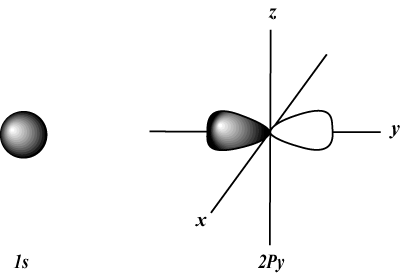
s orbitals are spherical, whereas p orbitals are dumbbell-shaped. d
orbitals and beyond are much harder to visually represent.
Please wait while we process your payment



