






 Ad-free experience
 Study Guides for 1,000+ titles
 Full Text content for 250+ titles
 No Fear Translations of Shakespeare’s plays (along with audio!) and other classic works
 Flashcards
 Mastery Quizzes
 Infographics
 Graphic Novels
 AP® Practice & Lessons
 Note-taking
 Bookmarking
 Dashboard













Why Trade?
Why should countries trade? Simply put, if a country can produce a good for less than another country, then the opportunity for advantageous trade exists. Of course, the opportunity for advantageous trade also exists when a country can produce a good that another country is unable to produce. In each of these cases, both the consuming country and the producing country will be better off with trade than without it.
Let's use an example to explain. Say Jim lives on an island with a coconut tree. Sally lives on another island with a banana tree. Jim tires of eating coconuts and desires something new to eat. Surprisingly enough, Sally is tired of bananas and would love some nice sweet coconut. In this example, trade would benefit both parties.
This example presents only one of the two cases in which trade is adventurous. In the other case, a country can produce goods at an absolutely or relatively lower price than another country. These conditions are called the absolute advantage and the comparative advantage respectively.
Advantages in Trade
A country may have two advantages over another country (or countries) regarding trade. Absolute advantage occurs when a producer can use the smallest amount of inputs to produce a given amount of output compared to other producers. Absolute advantage may apply to many countries. Comparative advantage happens when a producer has a lower opportunity cost of production than another producer. Comparative advantage may also apply to many countries, but in this SparkNote it will be restricted to cases of two countries and two goods. Each of these two cases will be discussed in detail in the following paragraphs.
Farmer John has a pistachio farm. It takes him five hours worth of work to harvest one pound of nuts. Farmer Rick also has a pistachio farm. It takes him four hours worth of work to harvest one pound of nuts. Farmer Erica owns a third pistachio farm. She can harvest one pound of nuts in three hours. In this example, Farmer Erica is said to have the absolute advantage in pistachio production since she is able to produce the largest amount of output in the smallest amount of time.
In terms of trade, it is always most beneficial for the producer with the absolute advantage in the production of a good to specialize in the production of that good. For instance, in the above example, it was far more productive for Farmer Erica to spend time harvesting pistachios than it was for Farmer Rick or Farmer John to do the same. Farmer Erica therefore has a lower cost of production than either of the other two producers. Applying this idea to international trade leads us to the conclusion that goods should be produced for which the cost of production is lowest.
In a more complex model though, producers can produce many different goods. Often times, if a producer chooses to produce one good, he or she must give up the opportunity to produce another good. This is called the opportunity cost of producing a good. The opportunity cost describes what is sacrificed or relinquished when one choice is taken over another.
Let's use another example. Revisiting the farms belonging to Farmer Erica and Farmer Rick, we discover that they are both able to produce pistachios and soybeans. Farmer Erica can harvest 1 pound of pistachios in 2 hours and she can harvest 5 pounds of soybeans in 2 hours. Farmer Rick, on the other hand, can harvest 1 pound of pistachios in 10 hours and 50 pounds of soybeans in 2 hours.
Looking at this information in terms of the total amount of time each farmer takes to harvest a pound of each product is the next step to understanding comparative advantage. Farmer Erica can harvest 1 pound of pistachios in an hour while it takes Farmer Rick 10 hours to harvest 1 pound of pistachios. On the other hand, Farmer Rick can harvest 1 pound of soybeans in about 2.5 minutes, but it takes Farmer Erica about 24 minutes to harvest a pound of soybeans.
Since each of these farmers only has a fixed number of hours to spend harvesting, each hour spent harvesting pistachios cannot be spent harvesting soybeans, and similarly, each hour spent harvesting soybeans cannot be spent harvesting pistachios. For every hour Farmer Erica spends picking soybeans, she gives up 0.5 pounds of pistachios; and for every hour that Farmer Erica spends picking pistachios, she gives up 0.1 pounds of soybeans. Farmer Rick gives up 25 pounds of soybeans for every hour that he spends harvesting pistachios, and for every hour that Farmer Rick spends harvesting soybeans, he gives up 0.1 pounds of pistachios.
We can reexamine this example in terms of opportunity costs. Farmer Erica has an opportunity cost of 0.1 pounds of soybeans for every 0.5 pounds of pistachios harvested, or similarly, 5 pounds of pistachios for every 1 pound of soybeans harvested. Farmer Rick has an opportunity cost of 0.1 pounds of pistachios for every 25 pounds of soybeans harvested, or 250 pounds of soybeans for every pound of pistachios harvested.
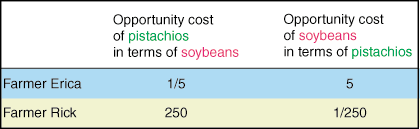
Figure 1 depicts the situation described above. Notice that for Farmer Erica, the opportunity cost of harvesting pistachios is lower than the opportunity cost of harvesting soybeans. Similarly, for Farmer Rick, the opportunity cost of harvesting soybeans is lower than the opportunity cost of harvesting pistachios. In both of these cases, this means that both farmers are better off spending their time harvesting the product that they can produce most efficiently.
The producer with the lower opportunity cost of production is said to have the comparative advantage. Notice that in a case with two producers and two products, each producer must have a comparative advantage in one, and not both, products. Figure 1 makes finding the comparative advantage easy. Simply represent the opportunity cost of one product in terms of the other product for both producers, and then compare these numbers. Whichever producer has the lower opportunity cost has the comparative advantage and should produce that product.
Absolute advantage and comparative advantage are theoretically straightforward. When a producer has an absolute advantage, he can produce a given output by using fewer inputs than any competing producer. When a producer has a competitive advantage, he can produce one product with a smaller amount of inputs than the competition. He therefore must produce another product with a greater amount of inputs than the competitor, hence the designation of comparative advantage. When either an absolute advantage or a comparative advantage exists, benefits from trade are guaranteed.



