Did you know you can highlight text to take a note?
x

Please wait while we process your payment


If you don't see it, please check your spam folder. Sometimes it can end up there.
If you don't see it, please check your spam folder. Sometimes it can end up there.
Please wait while we process your payment


By signing up you agree to our terms and privacy policy.
Don’t have an account? Subscribe now
Create Your Account
Sign up for your FREE 7-day trial
By signing up you agree to our terms and privacy policy.
Already have an account? Log in
Your Email
Choose Your Plan
Individual
Group Discount
Save over 50% with a SparkNotes PLUS Annual Plan!
 payment page
Purchasing SparkNotes PLUS for a group?
Get Annual Plans at a discount when you buy 2 or more!
Price
$29.99 $22.49 /subscription + tax
Subtotal $44.98 + tax
Save 25% on 2-49 accounts
Save 30% on 50-99 accounts
Want 100 or more? Contact us for a customized plan.
payment page
Your Plan
Payment Details
Payment Summary
SparkNotes Plus
You'll be billed after your free trial ends.
7-Day Free Trial
Not Applicable
Renews October 8, 2025 October 1, 2025
Discounts (applied to next billing)
DUE NOW
US $0.00
SNPLUSROCKS20 | 20% Discount
This is not a valid promo code.
Discount Code (one code per order)
SparkNotes PLUS Annual Plan - Group Discount
Qty: 00
SparkNotes Plus subscription is $5.99/month or $29.99/year as selected above. The free trial period is the first 7 days of your subscription. TO CANCEL YOUR SUBSCRIPTION AND AVOID BEING CHARGED, YOU MUST CANCEL BEFORE THE END OF THE FREE TRIAL PERIOD. You may cancel your subscription on your Subscription and Billing page or contact Customer Support at custserv@bn.com. Your subscription will continue automatically once the free trial period is over. Free trial is available to new customers only.
Choose Your Plan
This site is protected by reCAPTCHA and the Google Privacy Policy and Terms of Service apply.
For the next 7 days, you'll have access to awesome PLUS stuff like AP English test prep, No Fear Shakespeare translations and audio, a note-taking tool, personalized dashboard, & much more!
You’ve successfully purchased a group discount. Your group members can use the joining link below to redeem their group membership. You'll also receive an email with the link.
Members will be prompted to log in or create an account to redeem their group membership.
Thanks for creating a SparkNotes account! Continue to start your free trial.

We're sorry, we could not create your account. SparkNotes PLUS is not available in your country. See what countries we’re in.
There was an error creating your account. Please check your payment details and try again.
Please wait while we process your payment

Your PLUS subscription has expired
Please wait while we process your payment


Please wait while we process your payment
Force and Acceleration
For the sake of simplicity in this section we will switch to units in which c = 1. This seems like a strange and confusing thing to do, but in fact simplifies things immensely. In doing this we just ignore all factors of c and if we need them back at the end (of working a problem, say) we can just check where units of m/s are missing. In so-called relativistic units, p = γmv, as before, and E = γm. It is good to get used to c = 1 because many advanced treatments of Special Relativity use it extensively.
Unfortunately the old Newtonian law  is not much good to
us in Special Relativity because our concept of velocity has undergone a
radical change. Instead we must define the force on an object as the rate
of change of momentum:
is not much good to
us in Special Relativity because our concept of velocity has undergone a
radical change. Instead we must define the force on an object as the rate
of change of momentum:
F =  |
 = =     = =  = γ3va = γ3va |
 . Therefore we have:
F =  = m(v + γ = m(v + γ ) = ma(γ3v2 + γ) = γ3ma ) = ma(γ3v2 + γ) = γ3ma |
 = =  = m = m = γ3mv = γ3mv |
 =
=  =
=  = a, so:
| = γ3ma = F = |
In Special Relativity, force in two dimensions can become a strange, unintuitive concept. Most strangely, it is not always true that force points in the same direction as the acceleration of an object! Even though we are working in two, and not three, dimensions we can use the vector equation:
 |
 . The momentum is given by:
 |
 | |||
= m  + + 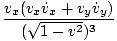 ,( ,( + + 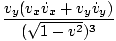  |vy=0 |vy=0 | |||
m ( ( , , | |||
| = m(γ3ax, γay) |
Say we have a force acting on a particle in its instantaneous inertial rest frame (it can only be instantaneous since the particle is accelerating due to the force on it) F'. Say F' is moving with speed v along the x-direction relative to another frame F. How can we relate the components of the force in the two frames? In F we have from above:
(Fx, Fy) = m γ3 γ3 , γ , γ  |
(Fx', Fy') = m  , ,  |
(Fx', Fy') = m γ3 γ3 , γ2 , γ2  |
 . The transverse force is a factor of γ larger
in the particle's frame.
. The transverse force is a factor of γ larger
in the particle's frame.
Please wait while we process your payment



